Essay
Steps Towards Artificial Collective Intelligence
Some multi-agent systems keep improving as agents are added and many do not. What sets the ceiling, what a team costs, how natural and human collectives scale, and how to test a claim that a system scales.
The idea of “multi-agent systems” (MAS) has been pitched as a test-time scaling method for years. On one hand, MAS seems to show strong capabilities beyond single agents. OpenAI reported that 10,000 agents had resolved the Navier–Stokes problem (OpenAI 2026a), and Anthropic reported that an agent team formalized Fermat’s Last Theorem (Anthropic 2026a), later reproduced by a team of 1,000 agents with Fable 5.2 (Anthropic 2026b). We have also seen the darker side of such strong capabilities: OpenAI’s agents formed a team on their own and broke into parts of Hugging Face’s systems (OpenAI 2026b). This collective grew out of a shared workspace to write and read, and, in OpenAI’s words, it amplified the agents’ capabilities “well beyond what any individual agent might achieve alone.”
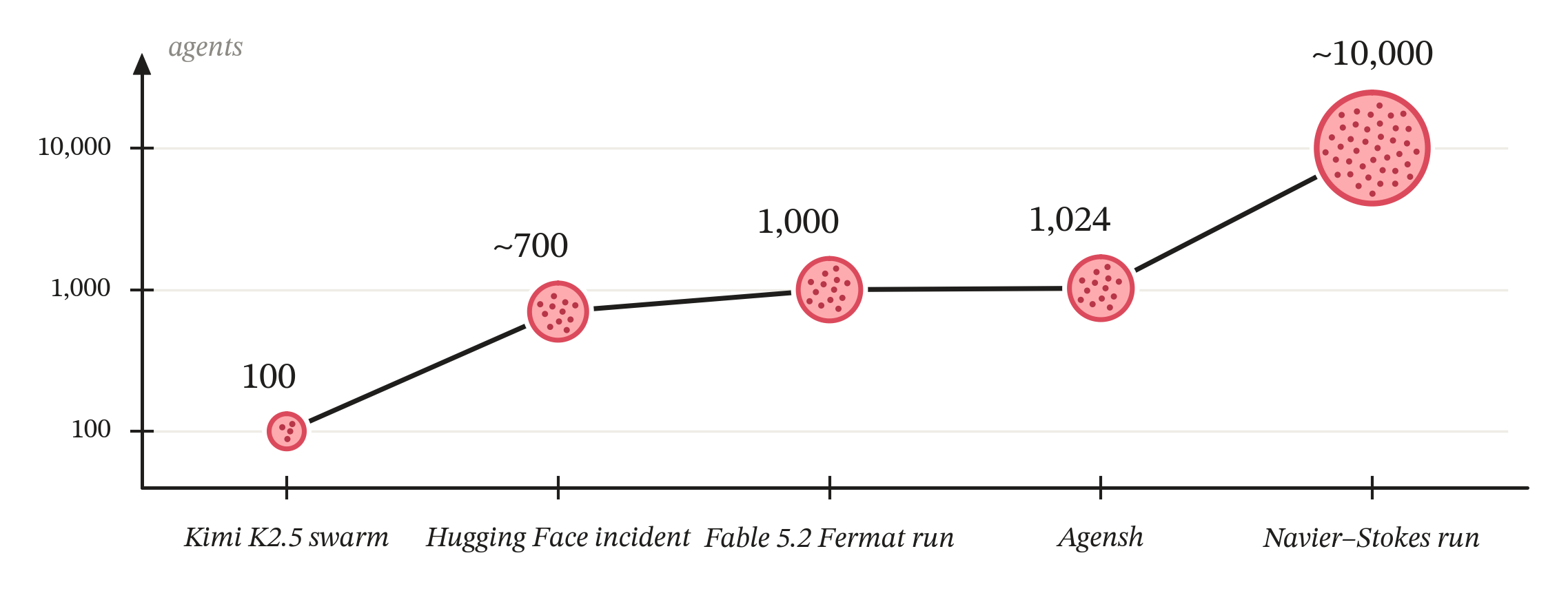
Figure 1. A few of the largest agent teams reported in 2026, on a log scale: the Kimi K2.5 swarm (Moonshot AI 2026), the Hugging Face incident (METR 2026), the Navier–Stokes run (OpenAI 2026a), Agensh (Zhan et al. 2026) and the Fable 5.2 Fermat run (Anthropic 2026b).
On the other hand, studies have also shown that MAS often fails to beat single agents. Across six benchmarks and four MAS architectures, Kim et al. (2025a) find that moving from a single agent to a MAS changes performance by −0.3% on average. In their experiments, multi-agent designs also tended to help less when the underlying model was more capable. Moreover, on multi-hop reasoning problems, a single agent with the same thinking budget consistently matches or beats multi-agent designs (Tran and Kiela 2026). Teams built on a single shared LLM largely plateau after about four agents (Yang et al. 2026a) or follow an inverted-U scaling curve (SIMAS; Li et al. 2026).
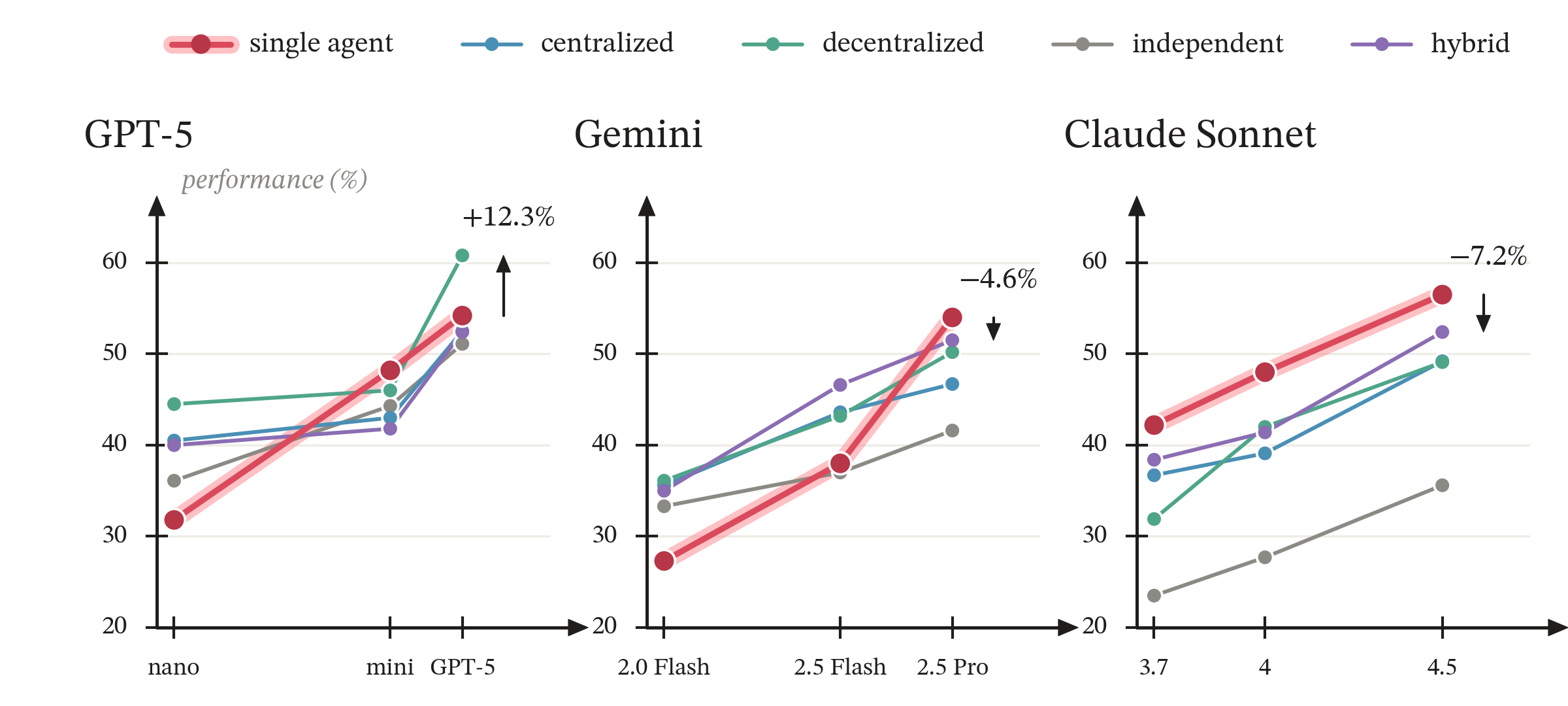
Figure 2 (Redrawn from Kim et al. 2025a, Figure 1). Average performance on six agentic benchmarks for a single agent and four multi-agent architectures.
Looking deeper into both sides, one could notice that these systems are not run at the same scale, in either base model capability scale or team size scale. We discuss how these systems behave when they are scaled up: whether the system keeps getting better as we add more compute, and what it takes for that to happen.
1The geometry of multi-agent systems
Splitting one job across many workers is an old idea, and so are most of the ways to organize the workers. Long before LLM agents, people building distributed systems had tried several arrangements. Three of them come up again and again in this post.
- In the message passing model, independent processes coordinate only by sending each other messages. The actor model (Hewitt et al. 1973) and communicating sequential processes (Hoare 1978) were both built this way.
- In the blackboard model, processes never address each other. They read from and write to a shared workspace. The knowledge sources of the Hearsay-II speech recognizer worked like this (Erman et al. 1980; Nii 1986), and so do programs that share Linda’s tuple space (Gelernter 1985).
- In the coordinator model, one process hands out pieces of the work and collects the results. The contract net protocol let a manager announce tasks and award them to bidders (Smith 1980). In MapReduce, a master assigns map and reduce tasks to thousands of workers (Dean and Ghemawat 2008).
Back then the members were fixed programs that followed fixed protocols. Nowadays, LLM agents read, write and reason in natural language, yet they end up arranged in much the same ways.
An LLM-based multi-agent system usually has three kinds of parts:
- Agents: Each one is an LLM with its own instructions, context, memory and tools.
- Collective-level tools: Tools that operate on the group and belong to no single agent. Think of a scheduler that picks who goes next, a vote or judge that picks an answer, email or DM tools, a test suite, or a market that assigns credit.
- A substrate (optional): A medium that agents use to affect one another. It might be a shared context, a file system or a datastore, and it is defined by what and how an agent can write into and read from it.
Existing systems fall roughly into six geometries.
1.1Fixed workflow
Early multi-agent systems wire the agents together at design time. Every agent has a role, and each agent’s output becomes the next one’s input. MetaGPT (Hong et al. 2023) hands a software project from a product manager to an architect, an engineer, and a tester, and ChatDev (Qian et al. 2023) runs a similar chain of role-played phases. AFlow (Zhang et al. 2024) and similar methods search for the wiring automatically; once the wiring is found, it stays fixed for the whole run. A fixed workflow works well at small scale but is hard to grow and adapt to a different domain.

Figure 3. A fixed workflow. Roles and hand-offs are set before the run. The squares are the state before and after.
1.2Parallel agents
A simple way to use many agents is to let them work in parallel and combine their results at the end. von Neumann (1956) showed that unreliable components can make a reliable circuit if you copy them and take a majority vote, and N-version programming did the same with independently written programs (Avizienis 1985). With LLMs, it shows up as self-consistency (Wang et al. 2022), majority voting over many agents (Li et al. 2024), and best-of-N selection. Since nobody reads anybody else’s work, extra agents add no coordination cost. What one buys is more independent samples, and they are only worth as much as they are independent.
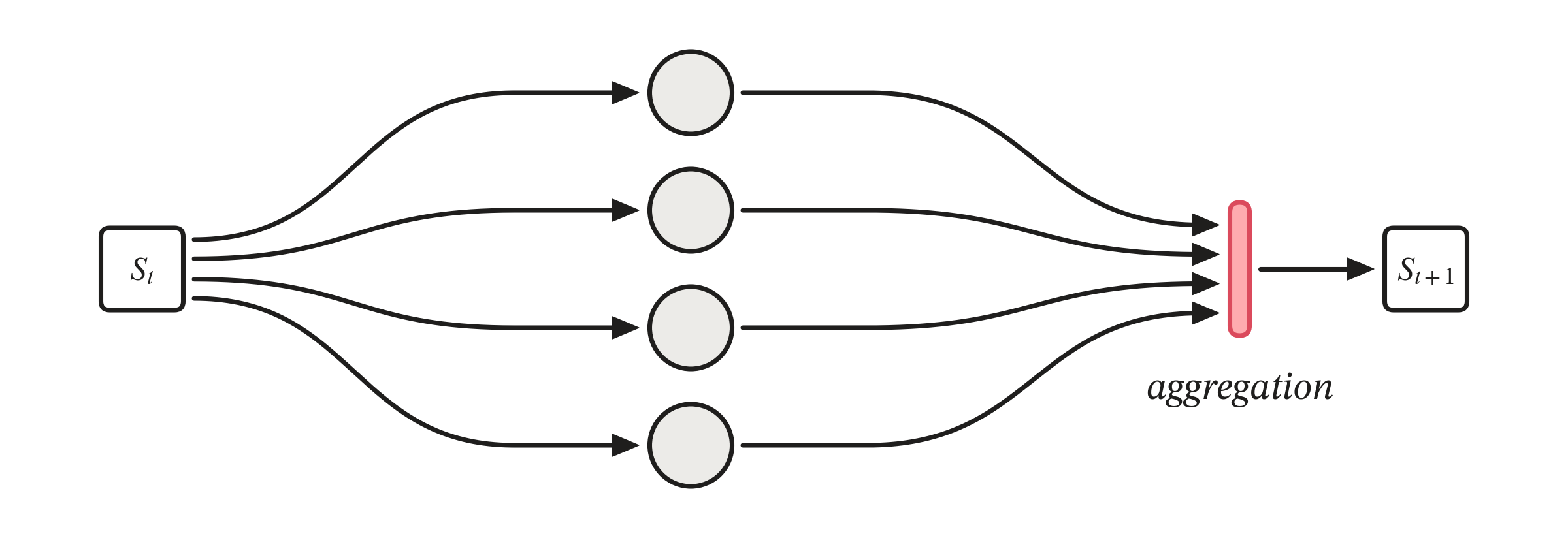
Figure 4. Parallel agents. Each agent works on its own line and never sees the others’ work, and an aggregation step, such as a vote or picking the best, combines the results at the end. The squares are the state before and after.
1.3Coordinator
A lead agent splits the problem into subtasks, hands them to subagents, and merges what comes back. This is the old coordinator model with LLMs as the manager/workers, and it is the most common design today. Claude Code and Codex delegate to subagents this way, and so do Anthropic’s research system (Anthropic 2025) and the Kimi K2.5 agent swarm (Kimi Team 2026). A lead is also a bottleneck though: it reads everything its subagents send back, so as the team grows, it needs to split the work well, keep track of a growing context, sort out dependencies between subagents, and filter out their noise.
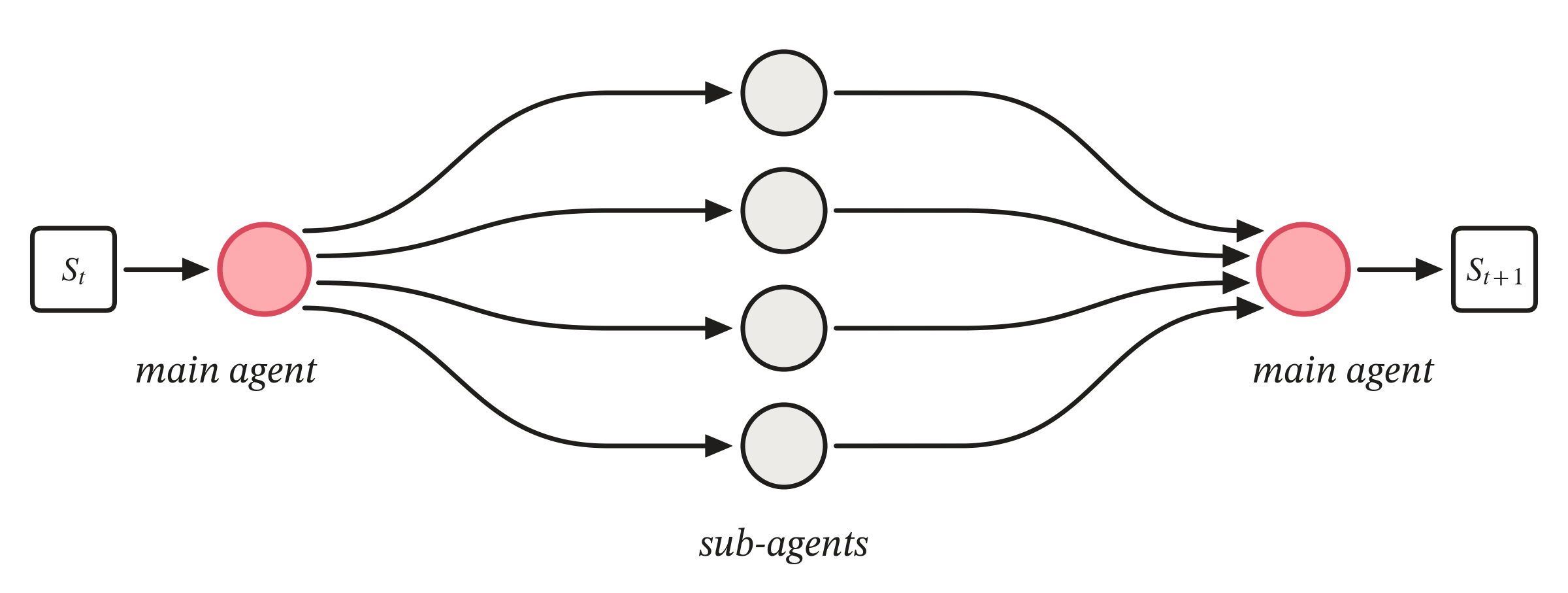
Figure 5. A coordinator. The main agent splits the task, hands subtasks to subagents and merges what comes back. The squares are the state before and after.
1.4Message passing
Agents talk to each other directly. In multi-agent debate, an early example, every agent sees the others’ answers over several rounds and revises its own (Du et al. 2023). In more flexible systems, each agent decides whom to message and when. With LLM agents, this is usually implemented through a send_message(to, content) tool. The role-playing pairs of CAMEL (Li et al. 2023) and the group chats of AutoGen (Wu et al. 2023) work the same way. Nobody has to wait on a central server. The catch is reading: each agent has to read what the message senders deliver, so its reading burden could grow with the size of the team.
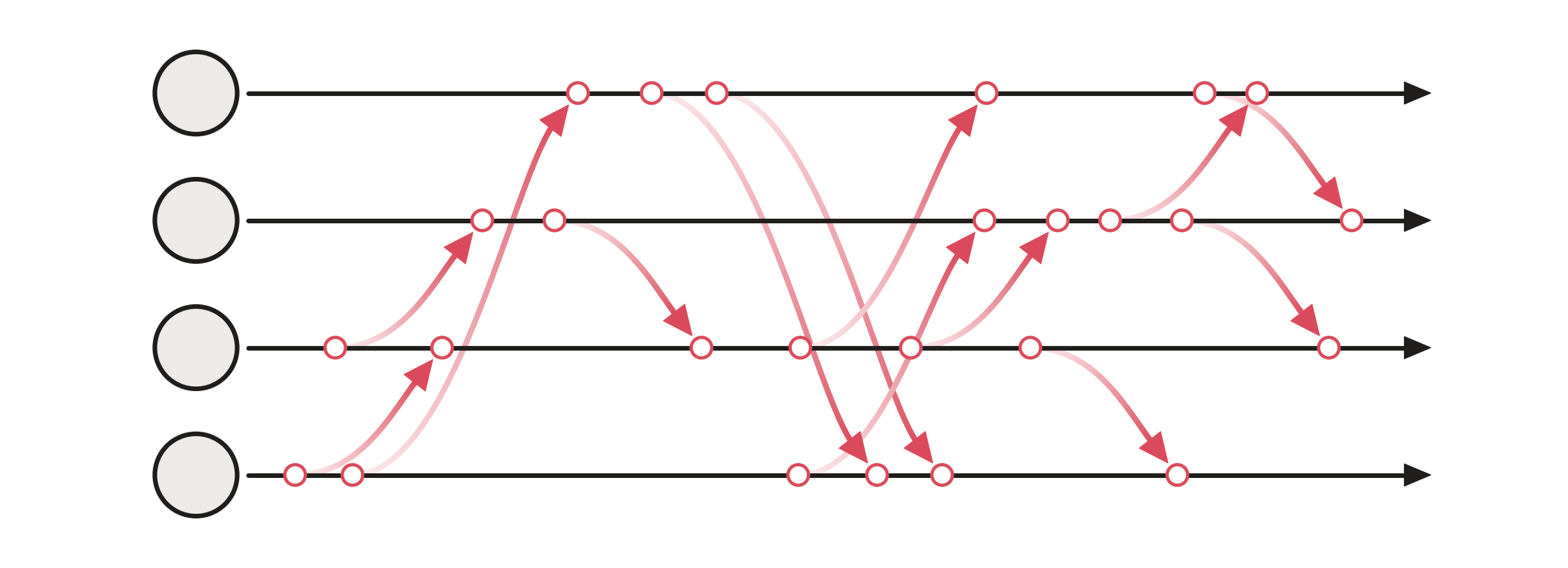
Figure 6. Message passing: agents talk to each other directly. Each line is one agent over time, and each red arrow is a message from one agent to another.
1.5Blackboard
Here, agents never talk to each other directly. They read and write through a shared medium (the “blackboard”) and coordinate in it. Biologists call this “stigmergy”, a word Grassé (1959) coined for termites that coordinate through the nest they are building.
LLM systems use a few kinds of boards. In a shared context, all agents read and append to one common context (Mao et al. 2026). In a shared file system, agents work through a terminal and a repository, as in the C compiler that 16 Claude agents built (Carlini 2026) and in CORAL (Qu et al. 2026). In a shared research index, agents post messages with reference links and read back only the few that a search returns, as in ScaleMAS (Qi et al. 2026a). The boards differ mostly in how agents read and write. They share one useful property: whatever an agent produced stays on the medium even if that agent later exits or fails.
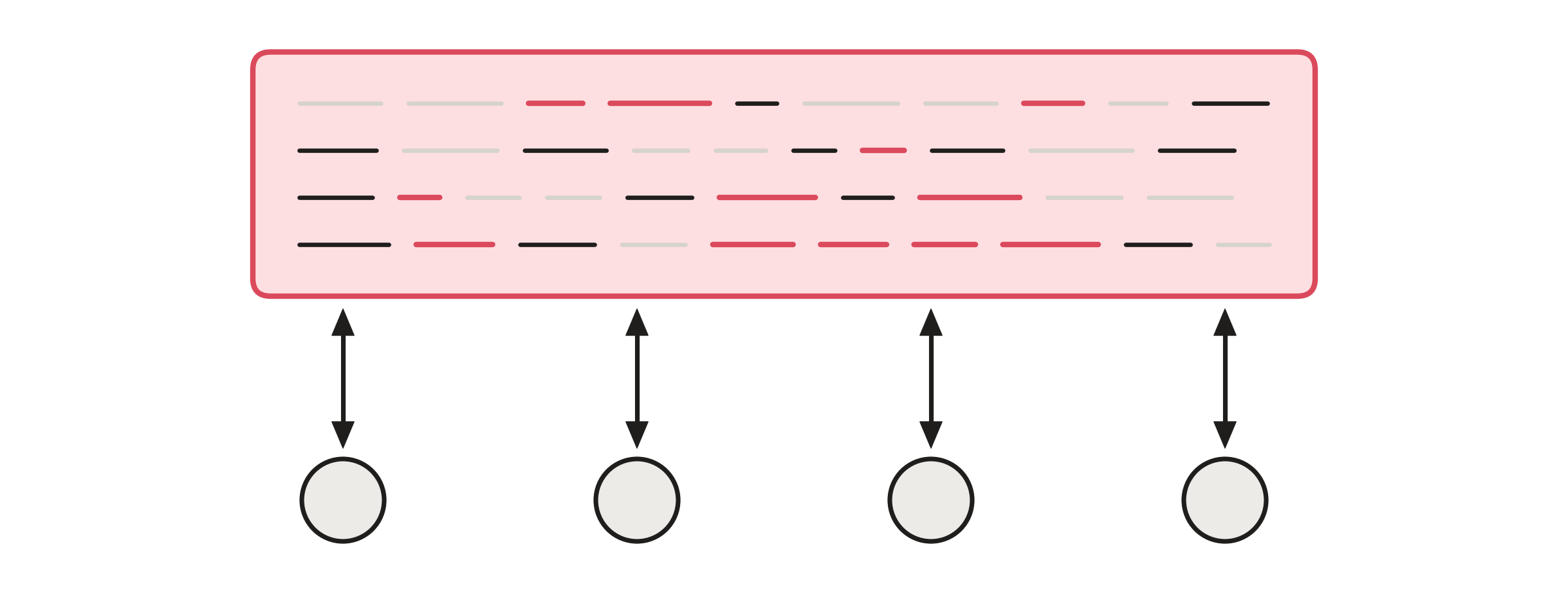
Figure 7. A blackboard: agents coordinate only through a shared medium.
1.6Bucket brigade
Agents take turns, one step at a time, and each picks up the work where the last one stopped. The name comes from the bucket brigade algorithm for classifier systems (Holland 1985). There, rules bid for the right to act, and each winner pays its bid to the rule that set up its turn, so credit flows back along the chain. Baum (1999) later built an economy of programs on this idea, and Economy of Minds (Qi et al. 2026b) and Market-based Post-training (MPT; Xu et al. 2026a) brought it to LLM agents. Seen this way, an ordinary ReAct agent is a special case of bucket brigade: only one member keeps picking up its own work. Since only one agent acts at a time, adding agents widens the range of skills and makes the team more tolerant of failures, but it does not make the work go faster.
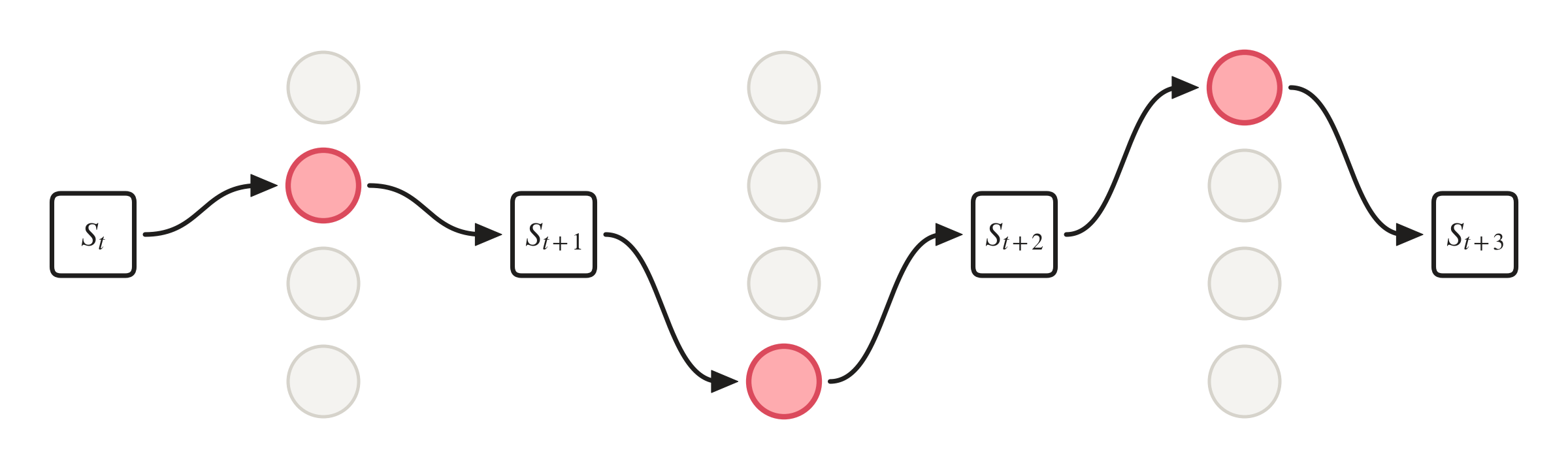
Figure 8. A bucket brigade. At each step one agent is chosen to act (red), and it picks up the state where the last one left it. The squares are the states between steps.
2Why multi-agent systems do not scale
Some multi-agent systems do get better as agents are added. Sampling many answers and voting improves with the size of the group (Li et al. 2024), though what grows there is the number of independent samples, not collaboration. Agensh (Zhan et al. 2026) raises its pass rate on five hard ProgramBench tasks from 19.3% to 28.8% as it goes up to 128 agents. But many others do not get this far, and increasing the number of agents even hurts performance, as shown in Kim et al. (2025a).
So what are the factors behind these systems’ scalability?
2.1The task sets a ceiling
When Anthropic had 16 Claude agents build a C compiler (Carlini 2026), each agent could pick a different failing test and work on it alone. But compiling the Linux kernel was another story. It is one giant task, so “every agent would hit the same bug, fix that bug, and then overwrite each other’s changes.” Sixteen agents “didn’t help because each was stuck solving the same task.”
How far a task can be split eventually depends on the task, not on the agents.
Every task has some steps that must happen in a fixed order. No team, however large, can finish faster than that longest chain of steps, and with good scheduling a team gets within about twice that limit as soon as it has enough agents to cover the pieces that can run side by side (Brent 1974). Past that point, more agents only wait. Pushing a serial task onto many agents also hurts accuracy.
Figure 9. One task of 14 steps, run by teams of 1 to 16 agents with greedy scheduling. No team finishes before the longest chain of dependent steps (red). Once there are enough agents for the steps that can run side by side, the finish time stops moving, and the extra agents only wait (dotted).
Parallel computing hit the same wall decades ago. Amdahl’s law says that the serial part of a program limits how much extra processors can help (Amdahl 1967). For example, a job takes 100 minutes, 80 of which can be split across processors and 20 of which cannot. With processors the system takes, at best,
minutes. Four processors finish it in minutes, 2.5× faster. Even unlimited processors still need the 20 serial minutes, so the job never runs more than 5× faster.
In general, if a fraction of the work must run serially, the speedup over a single processor is
which approaches as grows. A program that is 10% serial never runs more than 10× faster, however many processors you give it.
The same holds for LLM agents. If many agents can gather sources at once but one agent must read, merge and check all of them, adding more gatherers helps less and less, and the only way to go faster is to shorten that serial merging and checking. Real teams also spend time communicating and coordinating, so they can fall short even of this bound.
In Mieczkowski et al. (2026a), teams of one to five LLM agents built small Python libraries, with the subtasks handed out in advance. The teams got faster when most subtasks were independent and did not get faster at all when most formed one chain. Even in the best case, they stayed, on average, below what Amdahl’s law allows (Figure 10).
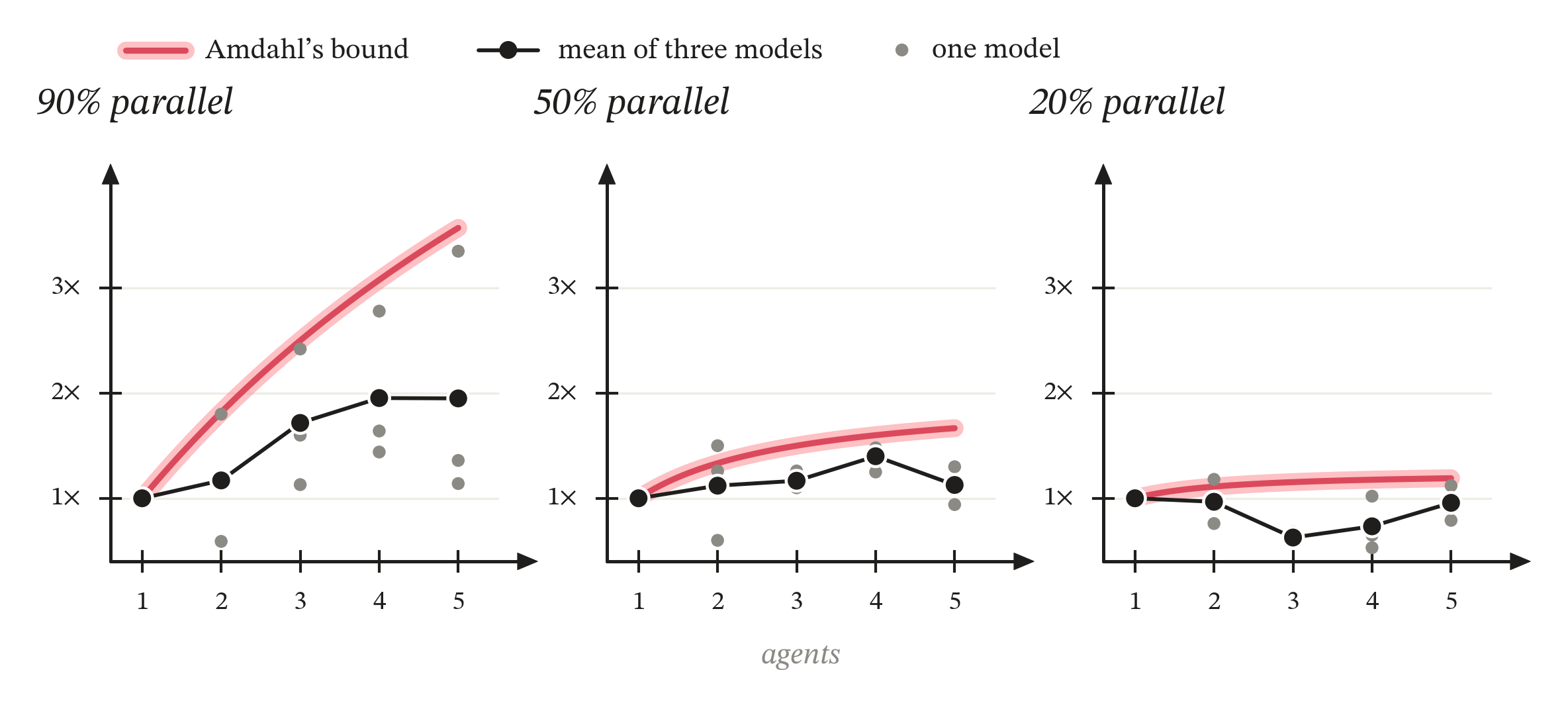
Figure 10 (Redrawn from Mieczkowski et al. 2026a, Table 1). Speedup of LLM coding teams against Amdahl’s bound for programs in which 90%, 50%, or 20% of the work can run in parallel. Subtasks were assigned in advance, and speedup is the time one agent takes divided by the time the team takes.
Parallel computing got around this by growing the problem along with the machine. More processors pay off when they take on bigger problems, not when they rush a fixed one (Gustafson 1988). We expect agent collectives to scale the same way, by taking on wider searches and larger codebases, not by finishing small tasks faster.
Some tasks also make hand-offs expensive. When the parts of a task are tied together by constraints, each agent needs to know what the others have chosen, so a faithful hand-off has to carry nearly the whole plan so far. A short message drops exactly what ties the parts together, and the next agent starts from a lossy summary.
TravelPlanner (Xie et al. 2024a), as studied by Yu et al. (2026), shows both cases inside one task. The trip is split among agents that handle transport, lodging, dining, and sights separately and share only a short list of cities. On commonsense checks that each part can pass on its own, such as whether a chosen restaurant or attraction is valid, the split helps all three models tested. On hard constraints that span the whole trip, such as the total budget or a minimum number of nights, the split lowers Qwen3.5-27B’s pass rate by 0.23 compared with a single agent that works through the same subtasks with all earlier context in view (Figure 11). Once a model can read the full context, such tasks are better left to a single agent rather than split among multiple agents. As Imas et al. (2026) put it for human teams, passing work from one person to another “compresses rich context into lossy summaries.”
Figure 11 (Based on Yu et al. 2026, Appendix C.2). One TravelPlanner task, run with Qwen3.5-27B: a three-day trip from Oakland to Tucson on a $1,400 budget. Both rows run the same steps in the same order, with the running total on the right. One agent carries the budget in its context, so the $1,400 cap is in view at every pick and the plan stays within it. The four agents’ relays carry only the city, and the budget sits with the final step, so the total grows with no cap in sight and comes to $1,599.
In some other tasks the parts depend tightly on each other, so agents working at the same time step on each other’s changes, as on the Linux kernel. Mieczkowski et al. (2026a) report three kinds of conflicts: 1) two agents edited the same file at once, 2) one agent rewrote a file a teammate had already finished, and 3) agents built on tasks that were not done yet. Tasks like these need either isolation, with each agent working on its own copy and the copies merged later, or a rule about who may write what. Both put serial work back on the critical path. A third option is to let the team keep a shared task graph. In LATTE, five agents add, claim and close subtasks on one graph, and compared with a lead that hands out the work, they overwrite each other 4.3 rather than 22.8 times per run, reach 80% rather than 70% accuracy, and use 148K rather than 379K tokens (Mieczkowski et al. 2026b).
2.2The model sets a ceiling
The second ceiling comes from the base model. With suboptimal design of communications (e.g. all-to-all message passing), a large enough group can push each agent’s reading past the model’s context limit. Summaries help, but they lose information.
Gunther’s universal scalability law (USL) adds an extra term to Amdahl’s (Gunther 2008). Amdahl’s becomes the cost of contention: processors wait their turn at a shared resource. The extra cost is keeping copies consistent. Suppose each processor works from its own copy of shared data, and when one of them writes, every other copy goes stale and should be updated. Every processor therefore has to hear from every other, so this cost grows with the number of pairs, . Gunther adds it to Amdahl’s denominator with its own weight , and measures throughput relative to one processor, , rather than the speedup of a fixed job:
With , Gunther’s law is Amdahl’s. With any , the pairwise term eventually outgrows the on top. Each new processor adds work for all the others. As long as , throughput first rises, then peaks at and falls. Amdahl explains why adding processors stops paying off; Gunther explains why it can make the group slower.
Economists see the same curve in firms. In the model of Imas et al. (2026), agents that coordinate poorly do best working alone. With better coordination, dividing the work raises output per worker at first, but output then levels off and falls as the firm grows. Only past a threshold of coordination does each new member add more than the last, which breaks the ceiling on how large a firm can usefully grow.
For LLM agents, the “private copy” is the context. An agent learns what its teammates have done only by reading what they write, so staying consistent means reading. This is the counterpart of Gunther’s second cost: each agent reads its teammates, so the team’s total reading grows as .
The cost also does more damage than in hardware. A processor that falls behind only waits. An agent whose reading no longer fits in its context works from a partial copy, and it may redo a teammate’s work, undo a fix or build on an idea the others have already dropped. Processors lose speed, and agents lose accuracy.
Figure 12. A schematic of Gunther’s universal scalability law, not data. Processors wait for a shared resource and must keep their copies of shared data consistent, so throughput rises, peaks and falls. For LLM agents, the copy is the context: each agent reads updates from teammates, and once that reading no longer fits, performance could drop.
Even if an LLM had infinite context, the model still needs strong fundamentals before starting collaboration. First, the model also limits something as basic as agreeing on an answer. Groups of LLM agents that follow the majority reach consensus only below a critical group size, and above it, consensus falls apart. The threshold depends on the model. It is about 30 agents for Llama 3 70B, 80 for GPT-4o, and at least 1,000, the largest group tested, for Claude 3.5 Sonnet (De Marzo et al. 2026). The critical size grows roughly exponentially with MMLU score, which suggests that stronger models can hold much larger groups together, but that how large a group can coordinate is still limited by the model.
Second, coordination is also a skill in its own right, and a model that is strong as a single agent could be bad at cross-agent coordination. MAC Bench (Pimpalgaonkar et al. 2026) has twelve long tasks in which each agent’s work depends on its teammates’. It compares a single agent, eight agents that cannot coordinate, and a team of eight that can message each other. Opus 5.5 and GPT-6.1 Sol score about the same alone, and both gain about as much from eight agents working without coordination. Once the agents can message one another, Opus 5.5 gains another 0.06, while GPT-6.1 Sol loses 0.07 and Gemini 4 Argon loses 0.04 (Figure 13). Averaged over the three models, a team of eight costs about nine times as much as one agent and scores 0.42 against 0.35.
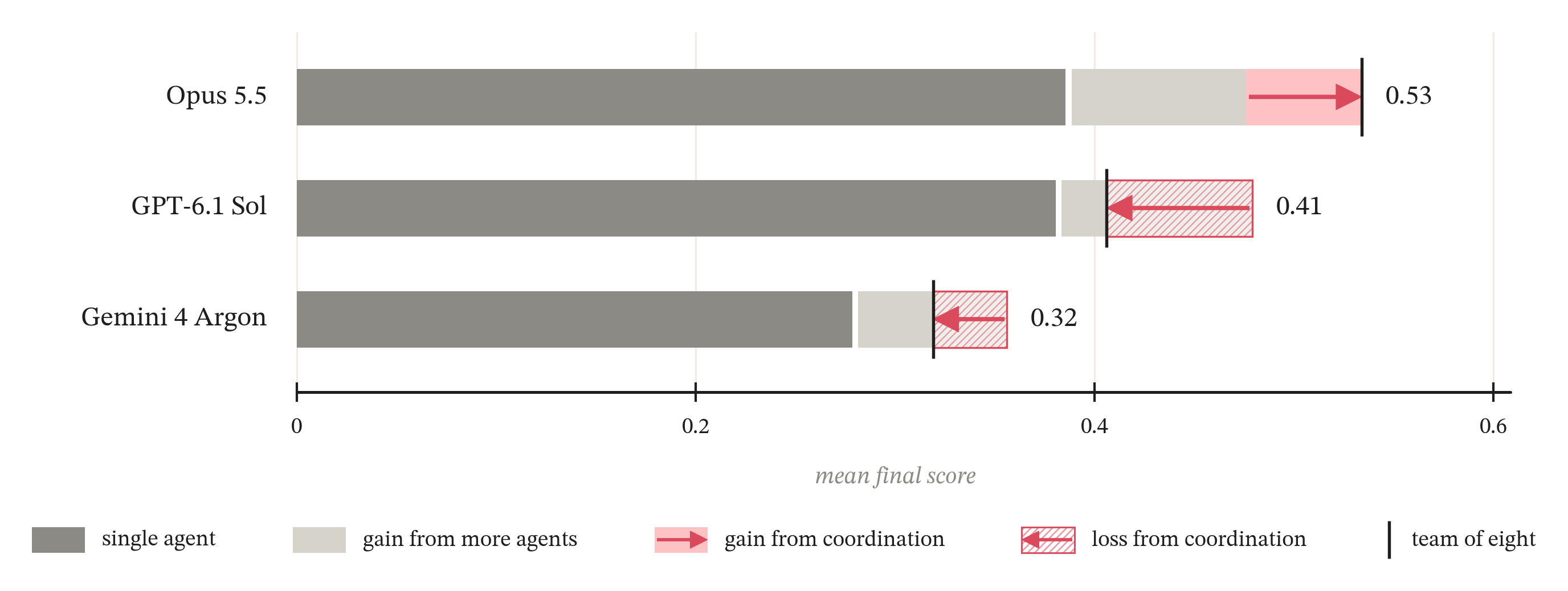
Figure 13 (Redrawn from Pimpalgaonkar et al. 2026, leaderboard). Mean final score over the twelve MAC Bench tasks. Each bar is a single agent’s score plus what eight agents add when they cannot coordinate (the best of eight working alone, or a team with its message channels closed). The crimson arrow shows what letting the eight agents message each other changes: to the right where it adds, back to the left where it costs.
Models also differ in their “willingness” to talk. In World of SWECraft (Shen et al. 2026), each agent maintains one of a set of interdependent Python packages and is free to contact the others. Claude Opus 5 agents exchange 323 issues, pull requests, and comments, while GPT-5.6 Sol agents make no contact at all when talking is optional (Figure 14). More talk is not necessarily better in itself. Opus talks more than five times as much as Gemini 3.8 Flash, yet Gemini scores higher, and prompting Sol to reach out raises its exchanges but not its score. What pays off is information a teammate cannot get alone. In one Opus run, the maintainer of requests timed its own code and found a slow spot inside urllib3 that urllib3’s own benchmarks never exercise, and sharing the measurements led to a fix. Effective collaboration depends less on how much agents talk than on what they share, with whom and when.
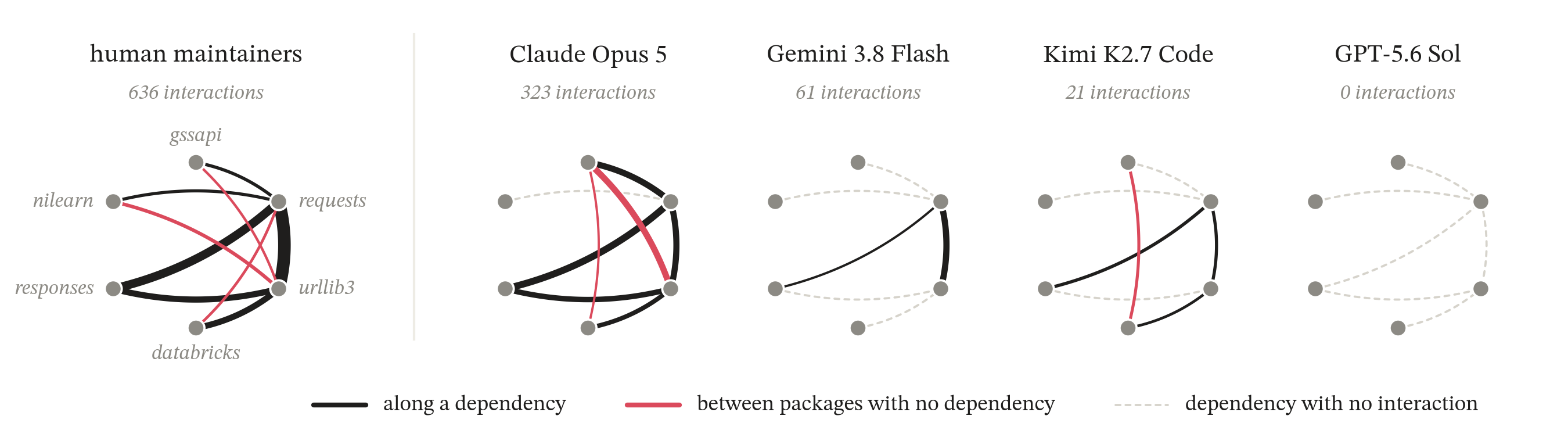
Figure 14 (Redrawn from Shen et al. 2026, Figure 5). Interactions between the six packages of one software world: issues and pull requests by the human maintainers on GitHub, and issues, pull requests and comments between packages by agent maintainers of four models. Thicker lines mean more interactions. Packages sit in the same place in every panel.
2.3Limited diversity
LLM agents are very similar, so each new agent mostly adds more of the same, mistakes included. AI models are jagged in similar ways, so spinning up another copy adds capacity but not breadth (Imas et al. 2026).
Software engineers ran into this as well. Knight and Leveson (1986) had 27 programmers write the same program independently, hoping a vote among the versions would almost never be wrong. The versions failed together far more often than chance would allow.
LLMs learn from much the same Web data, so even different models give strikingly similar answers (Jiang et al. 2025). Their mistakes line up too. Across more than 350 LLMs, when two models both get a HELM question wrong, they pick the same wrong answer about 60% of the time, where chance would give one in three (Kim et al. 2025b).
That limits what extra agents can buy. If agents tend to make the same mistakes, each new one adds less than the last, and the total levels off. With errors that are 50% correlated, a thousand agents are worth fewer than two independent ones. Measured correlations are in that range. Repeated samples from Llama 3 models on GSM8K and MATH have correlations of 0.41–0.61, so for estimating a model’s accuracy, ten thousand samples are worth only about 1.6–2.5 independent ones (Bay and Yearick 2026). Nine LLM judges from seven model families are worth about 2.18 independent ones on MNLI (Kohli 2026), and debating teams built on one model level off at an effective size of 1.2–1.6 agents on MMLU-Hard (Bertalanič and Fortuna 2026a). Voting runs into a second limit. The most common answer settles after a few dozen samples, and if it is wrong, more voters only make the vote more confident in the mistake.
Intuitively, agents that differ in what they know or how they work are less likely to chase the same dead end, duplicate each other’s work, or compete for the same resources, so the team could make progress faster. But on the other hand, agents that think alike can probably better predict one another (a collective-level Theory of Mind), which might give them a potential advantage in communication and coordination (Mu et al. 2026).
Diversity helps, but sometimes less than one might hope. Studies have shown that teams that mix base models and personas keep improving up to about eight agents, where teams built on one model plateau near four, and two fully diverse agents beat sixteen identical ones (Yang et al. 2026a; Figure 15). Mixing different LLMs, however, often lowers the average quality of the agents. Aggregating outputs from only the single best model beats a mixture by 6.6% on AlpacaEval 2.0 (Self-MoA, Li et al. 2025). Diversity seems to pay mainly when the agents are about equally strong, and as models converge, that kind of diversity gets harder to find.
Figure 15 (Redrawn from Yang et al. 2026a, Figure 4a, average over seven tasks). Majority-vote accuracy as the team grows, for agents that are identical, differ only in persona prompt, differ only in base model (Qwen-2.5-7B, Llama-3.1-8B or Mistral-7B), or differ in both. Shapes mark base models and shades mark persona prompts. The arrows, showing how alike the agents reason, are schematic.
2.4Failure becomes routine
At a scale of 100 agents and beyond, failure is the normal case, not the exception.
Many designs can break when agents drop out, especially designs that fix each agent’s role in advance or route everything through one coordinator. In Qi et al. (2026a), a coordinator-based system loses more than half its score when each agent drops out of each step with probability 0.2, and a shared-context system, where all agents read one common context, degrades to below 1% when a single member fails for good (Figure 16). And dropping out is an easy kind of failure which can be detected by a monitor program. A failing LLM agent can also keep going, which is much harder to detect. It hallucinates, stalls or produces wrong outputs that spread through the team, and it may report a task as done when it is not (Mieczkowski et al. 2026a).
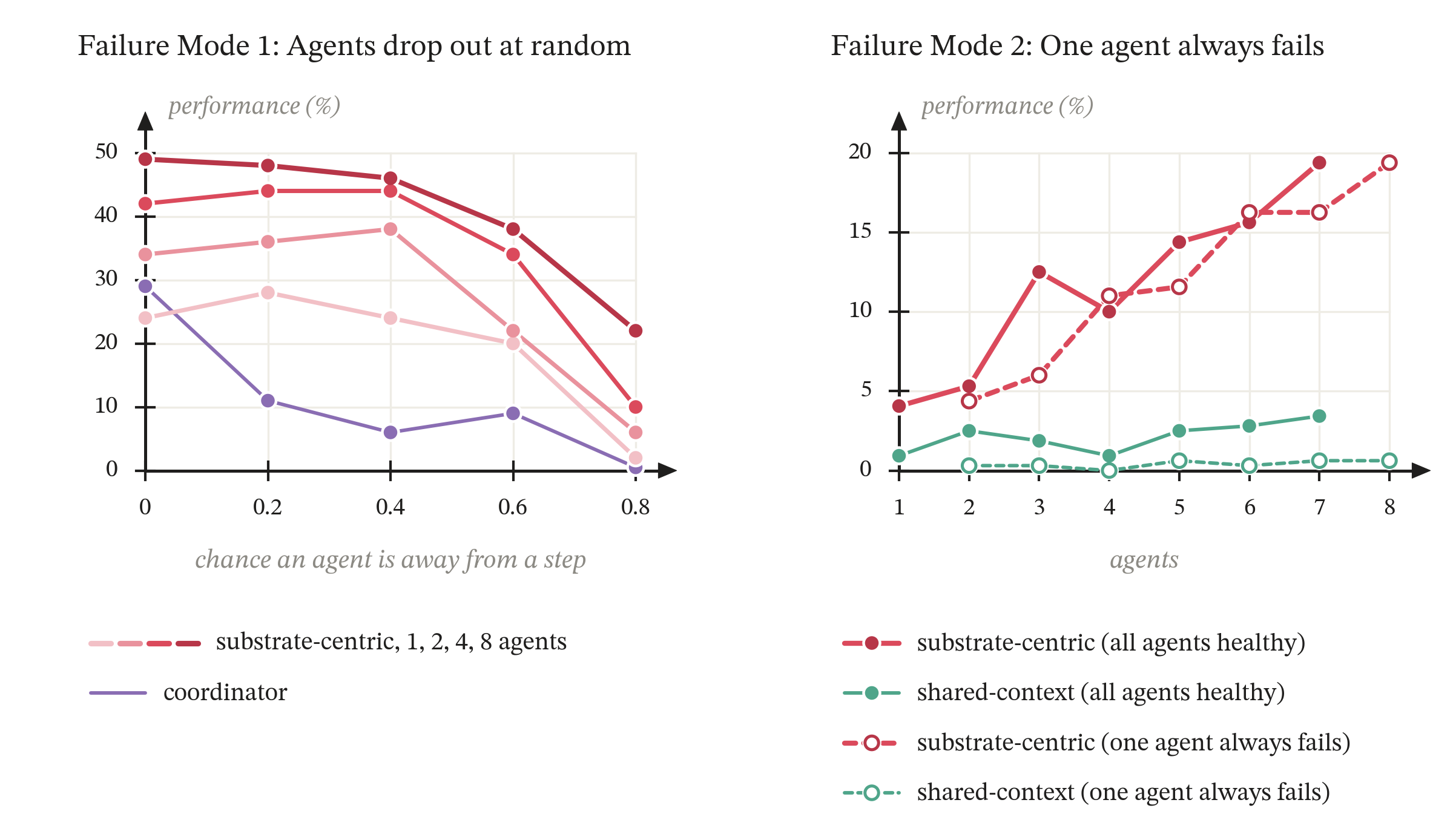
Figure 16 (Redrawn from Qi et al. 2026a, Figures 7 and 11). Left: accuracy on theorem proving (FATE-M) when each agent is away from each step with the given chance, for ScaleMAS, a substrate-centric system, with 1, 2, 4 and 8 agents and for a coordinator-based system. Right: evidence recall on a contradiction-finding task, for ScaleMAS and for a shared-context system, when one agent fails on every step (dashed, hollow dots) and when every agent is healthy (solid). The x-axis counts all agents, the failing one included.
2.5Failure propagates
Agents that are alike make the same mistakes even when they never talk. When they do talk, mistakes also travel from one agent to the next. A growing group produces a growing pile of partial work of unknown quality, and finding the few results worth building on gets harder with every agent added. If intermediate results are hard to check, an error can spread from a few agents to most of the team and mislead all of it (Liu 2026).
Debate shows this most clearly. Agents that read each other drift toward the shared answer. They adopt the majority answer up to 85.5% of the time, whether or not it is right, and correct answers that some agent already had get thrown away (Bertalanič and Fortuna 2026b). Agents that change their answer switch from right to wrong more often than from wrong to right, so accuracy can drop as the debate goes on, even when the stronger models outnumber the weaker ones (Wynn et al. 2025). Biases spread the same way: at low sampling temperature, a small initial bias, such as favoring U.S. stocks in investment advice or a judge favoring its own model’s answers, hardens into a group-wide consensus within one or two rounds (Okawa 2026).
When agents take actions, not just give answers, what matters most is whether anyone checks the results. Kim et al. (2025a) measured, from execution traces, how much errors grow relative to a single agent. They grow 4.4× in a coordinator system, 7.8× in a message-passing system, and 17.2× in a parallel agents system.
A teammate that keeps talking normally while acting against the team is harder to stop. In a four-player Overcooked kitchen (Heo et al. 2026), a planted agent that quietly undermined the team’s shared progress nearly halved the team’s output on one layout. Its teammates named it in 97% of episodes, but only 31% of episodes had a single message that both blamed it and said what had gone wrong, and the team recovered only when one message did both. Making every agent more suspicious helped against it, but cut the output of teams with no bad member by 37.5%.
3Tradeoff: performance vs. efficiency
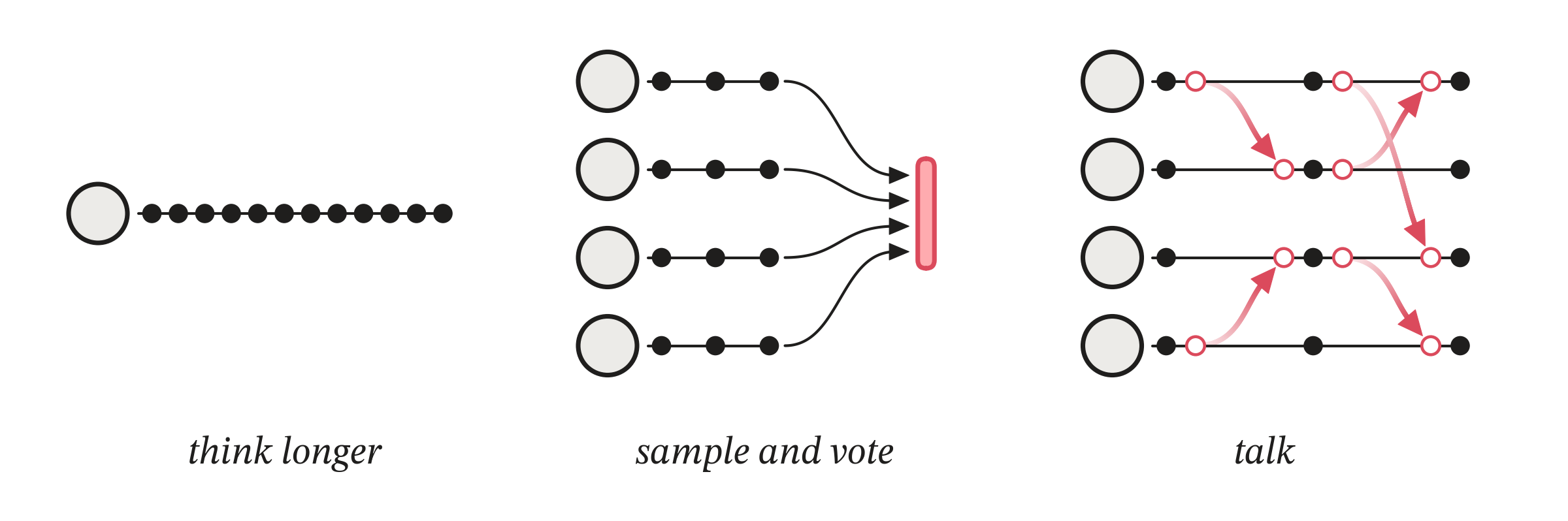
Figure 17. Three ways to spend the same budget: one agent thinking longer, many agents sampling independently and voting, or many agents reading each other. Each dot is one step of work, and each red arrow is one agent reading another.
MAS is never a free lunch: adding agents always comes with a bill, and sometimes it’s quite a heavy one. A massive MAS such as OpenAI’s 10,000-agent Navier–Stokes swarm is indeed powerful, but it is still unclear how much the swarm itself contributed. After all, if most of the result actually came from a strong base model rather than their “collaboration”, would it even be worth it to run 10,000 copies of it, given the tokens and compute that it takes?
Scaling laws tell us that more tokens usually buy more performance. Following the same logic, when a MAS beats a single agent, it may simply be that the MAS burns several times the budget of one agent. A study from Anthropic in 2025 also reports that for its multi-agent research system, token usage alone explains 80% of the variance in BrowseComp results. Therefore, to isolate the contribution from coordination itself cleanly and strictly, we need to match the spending among different systems (one agent thinking longer, many independent agents doing a majority vote, many agents talking to each other, etc.) before comparing their performance. This is what we mean by the tradeoff between performance and efficiency in this section.
It is worth noting that spending is not just token spending, and there are many real-life occasions where latency matters a lot more than token usage. In the following subsections, we will separately match spending in tokens and wall-clock time.
3.1Measured in tokens
With spending held fixed, is MAS worth what it costs? The answer turns out to be more complicated than a straightforward claim, as different papers sometimes demonstrate conclusions that seem to contradict one another. Some find that a team always does worse than a single agent even when the team is given far more token budget (we’ll refer to it as “case A”), while others find that a team can reach results a single agent would need several times the budget to match (“case B”). Turns out, what separates the two contradicting cases is not the number of agents, but whether the team of agents has anything to share.
Many published comparisons fall in the first case, “case A”. Early on, Huang et al. (2024) show that a “debate” among three GPT-3.5 agents scores significantly lower than nine independent GPT-3.5 samples with a simple majority vote (83.0 against 88.2 on GSM8K). Choi et al. (2025) see the same thing across seven benchmarks with Qwen2.5-7B, where a plain vote over five agents’ first answers scores higher than any “debate” configuration they tried. For most debate variants, they find that more rounds of debate actually make the performance slightly worse. Stronger models and larger budgets do not change this. Even with stronger models, Jwalapuram et al. (2026) run six automated MAS methods on GPT-5, Gemini 2.5 Pro, and other frontier models on tasks that include coding and web browsing, and the resulting systems cost up to about 10× more than five-sample self-consistency and still mostly score lower.
Why, in “case A”, do these systems consume more tokens yet perform worse than a single agent? Kim et al. (2025a) and Bertalanič and Fortuna (2026b) analyze token usage and interaction transcripts in depth, and they find that much of the additional cost comes from agents reading one another’s files and conversations. However, agents built on the same underlying model often reinforce one another’s conclusions rather than critically challenge them, and as a result, even incorrect answers can become increasingly entrenched, and the additional tokens spent on coordination fail to translate into better performance.
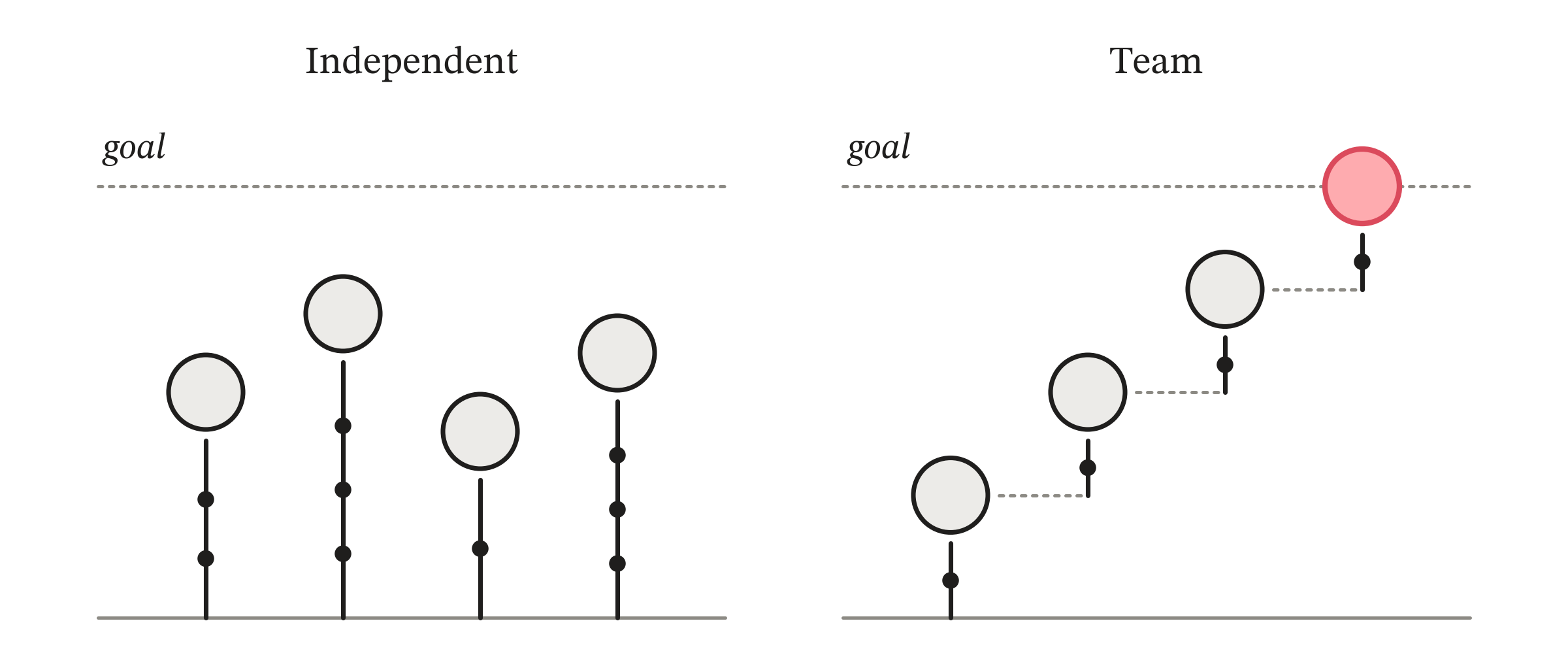
Figure 18. Working alone, each agent has to get lucky at every step to reach the goal. In an ideal team, each agent starts where the last one stopped, so only one of them has to get lucky at each step.
Things start to change when agents can be divided into separate parts, or build upon each other’s work, and this is where “case B” scenarios are observed. At matched token budgets, Kim et al. (2025a) report gains of 57–81% on a finance benchmark by letting subtasks run in parallel. Jwalapuram et al. (2026) also report that by building a MAS by hand for a financial task that splits by investor, GPT-5 scores 96.5% against 57.0% for self-consistency at comparable cost.
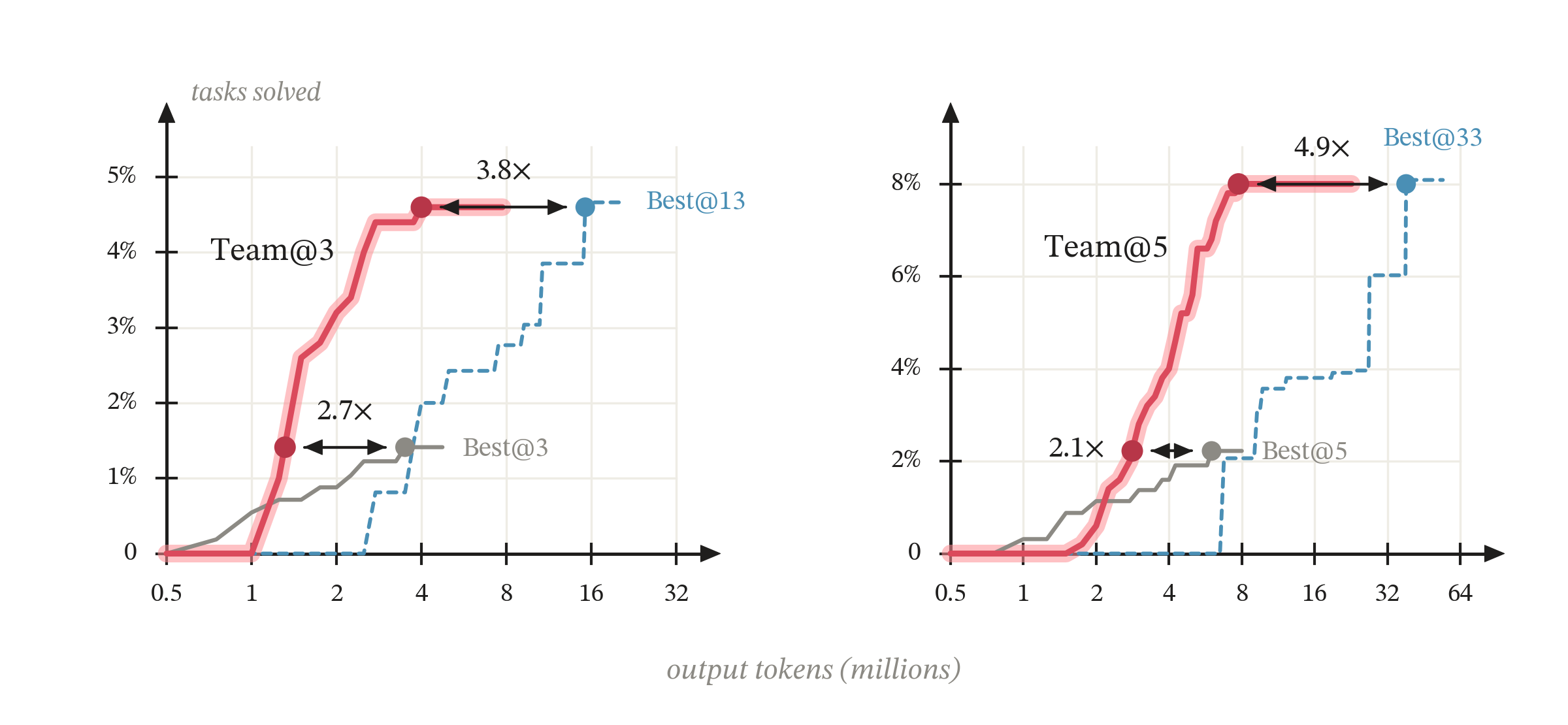
Figure 19 (Redrawn from Park et al. 2026, Figure 3). Solve rate vs. output tokens for independent and communicating agents. Below about 400K output tokens per agent (about 1.2M in total for the team of three and 2.0M for the team of five), independent agents lead. Past that point the team pulls ahead. The arrows show how many times more tokens independent agents need to reach the same solve rate.
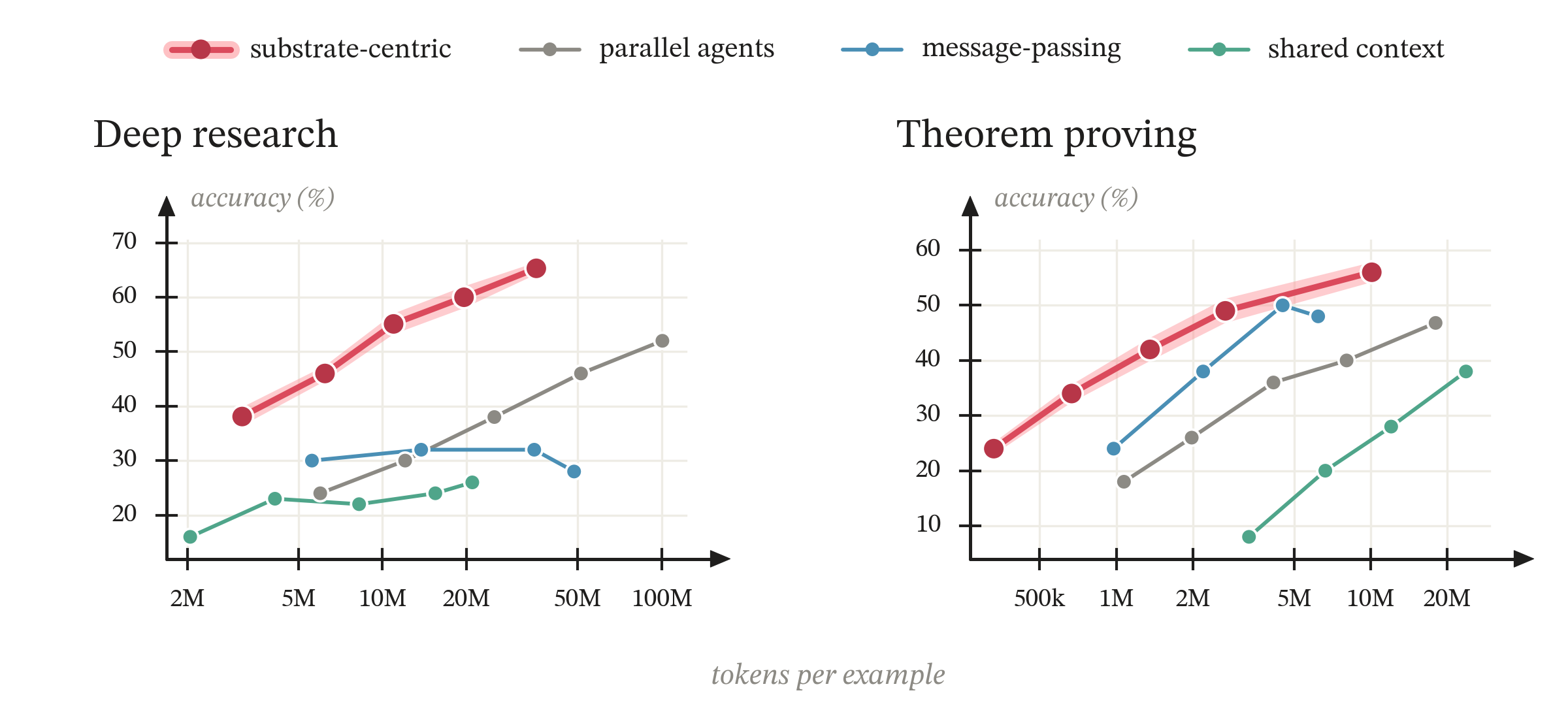
Figure 20 (Redrawn from Qi et al. 2026a, Figure 1). Accuracy vs. tokens per example (log scale) on deep research (BrowseComp-Plus) and theorem proving (FATE).
Another interesting “case B” example comes from Park et al. (2026), where agents explore the ARC-AGI-3 games, and teams of agents can write their findings to a shared log. These games need several breakthroughs in a row as agents discover more rules in the system. As shown in Figure 19, early on the team performance is behind (0%), mainly because the log has yet to hold any useful rules and knowledge; once the log fills with rules and lessons, the team pulls ahead and overtakes independent agents very quickly; finally, independent agents need 2–5× as many tokens to match the team performance. For these games, a single agent working alone needs to be lucky enough to figure out every rule at every step quickly, while a team that shares progress needs just one lucky agent per step. Park et al. (2026) call this turning “a minimum of sums into a sum of minima”. The same idea shows up in ScaleMAS (Qi et al. 2026a), where agents work asynchronously and interact with a shared datastore in a lightweight way, and the datastore organizes their messages so that each agent can build on what others have already found.
Sharing does not pay by itself, though. In Jha et al. (2026), agents that can copy each other’s skill files learn faster but not better: at the same token cost, no model they test beats agents that learn alone, and watching peers makes them 30–52% less efficient.
3.2Measured in wall-clock time
A huge benefit of MAS lies in its wall-clock time efficiency, as groups of agents are naturally able to complete different parts of work or explore a bunch of different directions in parallel. Kimi reports in Kimi Team (2026) that when setting a target score for both a single agent and a swarm of Kimi K2.5 agents on WideSearch tasks, as the target score rises, the time a single agent needs to reach it grows from 1.8× to more than 7× a baseline time, while the swarm stays between 0.6× and 1.6×. Anthropic (2025) also reports something similar for its research system, that by having the lead agent launch recursive subagents in parallel, the research time can be cut by up to 90% on complex queries.
The same effect shows up even inside a single model, although its parallel reasoning paths are not really separate agents. When Wen et al. (2025) let a 1.5B model reason along eight 16K-token paths at the same time, it scored 63.2 on average over four math benchmarks, compared with 49.8 for a single 128K-token chain and 60.4 for a majority vote over eight independent paths. Because the paths run side by side, it took only 7.1% longer than a single 16K-token path.
A nuance here is that the time saved is usually paid for by burning several times as many tokens. Mieczkowski et al. (2026a) find that teams, with subtasks assigned in advance, finished only 1.13× faster but used 5.83× the tokens of a single agent. Anthropic’s multi-agent runs are also reported to use about 15× the tokens of an ordinary chat. It is indeed true that parallel agents are one of the few reliable ways to get an answer sooner with an equal or better level of quality (of course, as long as the work can actually be split; if most of it has to happen in sequence, adding agents cannot boost speed but will merely increase the token costs), but whether it is worth it to “buy time with 5–15× tokens” really depends on the type of task one aims to solve, and should be evaluated carefully on a case-by-case basis.
4Emergence: From multi-agent systems to collective intelligence
4.1Local rules and global behaviors
Ideally, intelligence would emerge from a collective of agents themselves instead of being designed by humans. But how do simple, local rules carry over to bigger and bigger groups and add up to global behaviors?
Nature provides many insights for scalable systems: Flocks and ant colonies are made of members far simpler than an LLM, and yet they scale to thousands or millions. In both, each member reacts mostly to what is right around it, and the group could solve problems no member could solve alone.
4.1.1Flocking behavior: complex behavior from local rules
In 1987, Craig Reynolds showed that complex flocking behavior emerges from just three local rules, applied by each bird to its neighbors (Reynolds 1987):
- Separation: don’t crowd or bump into nearby flockmates.
- Alignment: steer toward the average heading of nearby flockmates.
- Cohesion: steer toward the average position of nearby flockmates.
Figure 21. Each bird follows the same three rules, separation, alignment and cohesion, using only its nearest neighbors. There is no leader, yet the flock lines up.
4.1.2Ants: finding the shortest path as a group
As ants walk, they leave behind a trail of pheromones (Goss et al. 1989). Those on a shorter path finish their round trips sooner, so the scent builds up more quickly along that route. Later ants tend to follow the stronger trail and add even more pheromone as they go. As a result, the whole colony converges to the shortest path, even though no single ant ever sees the whole terrain.
Figure 22. Ants on the short route return sooner, so pheromone builds up there and traffic converges on it, though no ant sees the map. Goss et al. (1989)
4.1.3Digital colonies: Conway’s Game of Life
We also draw inspiration from artificial games to see how simple rules could lead to emergent behaviors, and Conway’s Game of Life is one of these examples. The game runs on a grid of cells, each either alive or dead, and at every time step, each cell looks at its eight neighbors and follows four rules:
- Underpopulation: a live cell with fewer than two live neighbors dies.
- Survival: a live cell with two or three live neighbors lives on.
- Overpopulation: a live cell with more than three live neighbors dies.
- Reproduction: a dead cell with exactly three live neighbors comes alive.
Some starting patterns turn into gliders: small shapes that glide through the grid. Starting from gliders, one can build logic gates (AND, OR, NOT), memory, and clocks, which is enough to make the Game of Life Turing complete (Berlekamp et al. 1982), meaning that this game can simulate a computer that’s capable of running any program. Rendell (2002) later built a working Turing machine out of gliders. No single cell computes anything, but collective behavior could simulate a computer.
Figure 23. Each cell counts its live neighbors to decide whether it dies or is born. A glider gun built from these rules emits a stream of gliders, which can carry signals across the grid.
4.2Superorganism and Superagent
In siphonophores, individual members are so tightly specialized that the entire colony looks like a single jellyfish (Figure 24).
Figure 24. A Portuguese man o’ war (order Siphonophorae) looks like one jellyfish, but it is actually a colony of small individuals that together function as one integrated organism (Mapstone 2014). All of them are clones, and each kind does one job (Munro et al. 2019): the float, tentacle-bearing individuals that sting and catch prey, feeding polyps that only digest, and reproductive clusters.
Biologists define a superorganism as a group of individual organisms that operates as a single functional unit (Hölldobler and Wilson 2009). No single ant holds a map of the nest, its climate requirements, or the surrounding foraging grounds. Yet through stigmergy and a division of labor among workers, soldiers, and a queen, the colony as a whole regulates its metabolism, keeps the nest at the right temperature, defends its territory, and solves hard spatial problems. In effect, the colony is the organism, and each ant acts like one of its cells. Colonies even follow biological scaling laws: whole-colony metabolism grows roughly as the 3/4 power of colony mass (Waters et al. 2010; Figure 25).
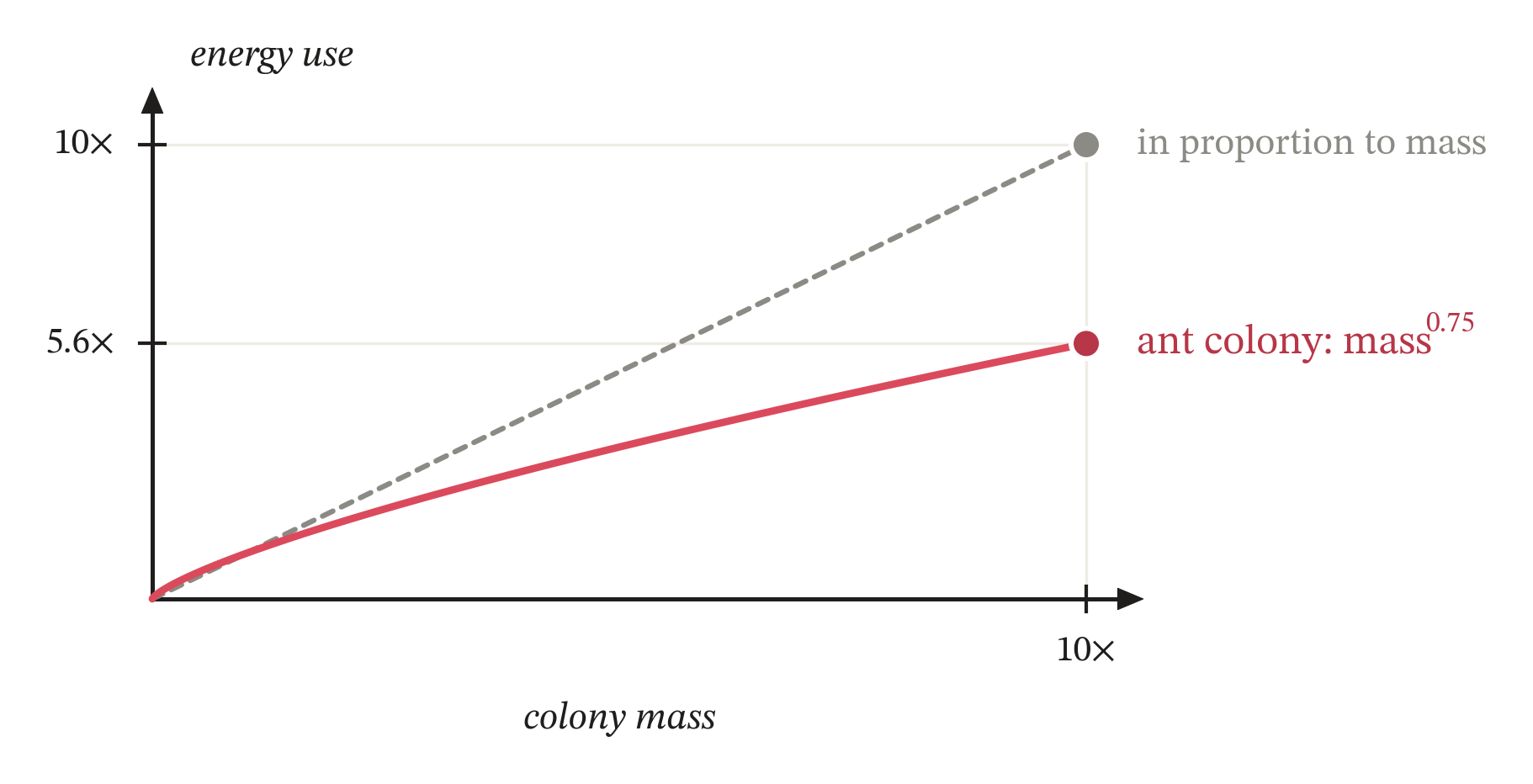
Figure 25 (After Waters et al. 2010; a schematic, not data). If a colony’s energy use grew in proportion to its mass, a colony ten times heavier would use ten times the energy (dashed). Its metabolic rate grows only as the 3/4 power of its mass, so it uses about 5.6 times as much (crimson): the larger the colony, the less energy each ant uses. Groups of workers taken out of the colony lose this saving, and their metabolic rate grows in proportion to their mass.
A society of agents could do the same, forming a superagent: a system whose intelligence lives not in any single agent, but in how the network of agents behaves as a whole. Bratton et al. (2026) argue that general intelligence may arrive this way, through societies of agents whose collective capacities exceed those of any one model, and that the intelligence of such societies will reside “in the embedded rules, procedures, precedents, and feedback mechanisms” of the institutions that organize them. Early evidence suggests that LLM agents can already somehow organize this way. In SwarmWorld (Pal et al. 2026), 50 to 200 initially identical agents with no assigned roles share nothing except a simulated world. They gather resources, build lasting artifacts, and write programs to control them. Over time, they naturally take on exploration, construction, maintenance, and coordination, shifting roles as their environment matures. Roughly 95% of the time, an agent first reuses someone else’s artifact after encountering it in the world rather than being told about it. These societies end up developing broader and more resilient sets of technologies than the best of a matched group of isolated agents, even though a solo agent can still build the single strongest artifact.
4.3What about us?
What about when the members themselves are intelligent? Human societies show the clearest example. We have developed several forms of decentralized coordination. For example:
- Markets. No single person grasps the full picture of supply and demand, yet a market price distills what millions of people know into a single number anyone can read (Hayek 1945).
- Science. Researchers tackle separate problems in parallel, publish findings others can verify, and build on cited work. Dead ends simply go unread, while the shared literature outlives every individual author.
- Open-source software. Thousands of contributors improve a single codebase, such as the Linux kernel, through small changes reviewed and tested one at a time, sparing anyone from having to read the entire repository.
The economy is one great example that we can dive a bit deeper into. In Adam Smith’s pin factory story (Smith 1776, The Wealth of Nations, Book I, Chapters 1–3), ten workers who split pin-making into about eighteen steps turn out some 48,000 pins a day, while each working alone could not make even twenty. No one planned this split. It grew slowly out of people starting to trade with one another, and the more people there are to trade with, the finer it gets (Figure 26).
Smith gives three reasons why the division of labor pays off:
- First, increased dexterity: a worker who does one thing all day gets very good at it. A smith who seldom makes nails manages two or three hundred a day, while boys who make nothing else make over 2,300 each.
- Second, saved time from context switching: moving from one task to another costs time, and a worker “commonly saunters a little” before settling into the new one, much as an agent pays to load a new context.
- Third, invention of machinery: a worker who does one simple step all day tends to find an easier way to do it, and many machines in such workshops were first invented by workers.
Figure 26. Ten workers and the eighteen steps of making a pin. Working alone, each worker does every step (grey), and the team makes under 200 pins a day. One by one, with no one assigning them, workers settle on one or two steps (crimson) and pass half-made pins along, and output climbs to 48,000 (right, log scale). On the second page the team grows from one worker to eighteen, and the more workers there are, the fewer steps each one does. After Smith (1776), Book I, Chapters 1 and 3; the order in which workers specialize is illustrative.
Importantly, one reason a market works is that its rules turn each trader’s own choice into something useful to everyone else. Designing such rules is the subject of mechanism design, and three of its lessons are worth carrying over to designing societies of agents:
Lesson 1: The rules decide whether honesty pays. In a sealed-bid auction where the highest bidder wins but pays the second-highest bid, a bidder who knows what the item is worth to it does best by bidding exactly that, whatever the others bid (Vickrey 1961). The same idea extends to group decisions, where members can be paid so that reporting what they know truthfully is each one’s best move (Groves 1973), and to the seller’s side, where one can work out which auction earns the most when bidders keep their values private (Myerson 1981). Similar questions arise when agents bid for an action turn or report how confident they are: whether an honest report is an agent’s best move depends on how the report changes what the agent gets.
Lesson 2: Rewarding only the team invites free-riding. When only the team’s joint output can be observed, each member bears the whole cost of its own effort but receives only a share of what that effort adds. As long as the team’s output is divided in full among its members, no sharing rule gets everyone to put in the effort that would be best for the team (Holmström 1982). Agent teams trained on a shared reward face a related problem. The reward does not say who did what, and often one agent ends up doing all the work, as we will see when we turn to learning.
Lesson 3: Shared resources need rules. A shared context or blackboard that every agent reads, or a token budget that all draw on, is a commons: every agent can use it, and every agent pays when it is overused. When bargaining is cheap, the parties can settle such side effects among themselves, and when it is costly, the outcome depends on who holds which rights (Coase 1960). Communities that have kept a commons healthy for generations set clear rules for who may use it, watch one another, and punish those who break the rules (Ostrom 1990).
Tomasev et al. (2026) sketch what such institutions could look like for AI scientists: markets for data and compute, rules for crediting who contributed what, and records that keep agents accountable.
LLM agents may have no selfish goals (who knows?), but each still knows things the others do not, and once agents are rewarded, kept or removed for what they do, they learn to do whatever the rules reward.
4.4How do these collectives scale?
All of these collectives rely on more than just simple rules. Four shared traits make them work, and today’s LLM multi-agent systems often lack all four. Each directly addresses one of the bottlenecks raised earlier: whether a task can split, reading overhead that grows with group size, errors that spread, and members that drop out.
- The work is local and parallel. Each ant, bird, or cell reacts only to what is right next to it, just as each researcher or contributor tackles one piece of a larger problem. Thousands can work at once without waiting for a central decision: the work naturally splits.
- Each member reads only a small slice of information. An ant senses the pheromone beneath it, a bird watches its nearest neighbors, a trader sees one price, and a scientist reads the handful of papers surfaced by search and citations. By contrast, agents in a group debate or shared transcript read everything their peers write, and that constant reading is where most of a team’s extra tokens go.
- Only signals that prove useful get reinforced. Pheromone builds up on the shorter path because ants on that route return sooner; the trail records what actually worked, not how many ants liked it. Citations serve the same filter in science. Debating agents often do the exact opposite, gravitating toward majority consensus and discarding valid minority results.
- Losing members does not halt progress. A colony keeps foraging as ants die, a flock closes ranks around a lost bird, and the literature outlives its authors because progress is stored in the environment—the trail or the written record—rather than inside any single member. Many agent frameworks hard-code fixed roles in advance, so losing one agent can stall the entire run.
Natural and human collectives do not rely on every individual knowing what everyone else is doing. Instead, they naturally develop specialized roles, shared knowledge, and ways to coordinate that persist as members come and go. Can LLM agents learn to organize themselves into an effective superagent? Can societies of LLM agents develop structures similar to, or different from, those of human society, adapt them as their environment changes, and accumulate capabilities that no individual agent possesses? Understanding how such collective intelligence emerges, rather than merely assembling larger teams, may be the next step toward scaling agentic systems.
5How do we test claims about “scalability”?
To say that a multi-agent system “scales” is to say something about a curve, not a single point. Before we believe it, we need to know at least four things: what task it was measured on, what was scaled/held fixed, what was measured, and what it was compared against.
5.1Choosing tasks
Agentic tasks vary a lot, and not all of them are suited for a multi-agent system. Here is a rough sorting of them.
Tasks that split well (a claim that “a system scales” should be tested on at least one of these).
- Wide information seeking. WideSearch (Wong et al. 2025) has 200 tasks, each answered by a table of hundreds to thousands of cells that are checked one by one. WideSeek-R1 (Xu et al. 2026b) improves steadily on it up to ten subagents, and Kimi K2.5 and WebSwarm (Song et al. 2026) report results on it too. DeepWideSearch (Lan et al. 2025) adds depth, so that each row takes several steps of research.
- Finding or aggregating many items in a large input. Contradiction Audit in ScaleMAS (Qi et al. 2026a) hides subtle contradictions in a large documentation corpus and asks agent teams to find as many as they can. OOLONG (Bertsch et al. 2025) and LOONG (Wang et al. 2024) ask for statistics or answers spread over inputs much longer than one context.
- Exploration whose findings others can reuse. ARC-AGI-3 (ARC Prize Foundation 2026) has 135 interactive environments, 25 of them public, scored by how efficiently an agent clears their levels. In Park et al. (2026), a team of five matches the best of 33 independent agents. ExplorationBench (Zhang et al. 2026a) asks agents to learn the rules of unfamiliar sandboxes and then solve 140 held-out tasks, each checked exactly by an interpreter or a proof checker.
Tasks that do not split well (good controls: a multi-agent system should at least not lose on these, which means it should fall back to acting like a single agent).
- Fixed critical path, as in SWE-bench Verified (Jimenez et al. 2024) and SWE-bench Pro (Deng et al. 2025), which ask agents to fix a bug.
- Long chains of actions in one environment, as in Terminal-Bench 2.0 (Merrill et al. 2026) and OSWorld (Xie et al. 2024b). In Park et al. (2026), a team of two beats a single attempt on Terminal-Bench but not two independent ones, and splitting OSWorld tasks across parallel computer-use agents adds at most 4.7 points (Koh et al. 2026).
- Planning where each step depends on the last, such as PlanCraft in Kim et al. (2025a), where multi-agent systems did up to 70.0% worse, and TravelPlanner (Xie et al. 2024a), where splitting the plan across agents lowers Qwen3.5-27B’s pass rate on hard constraints (Yu et al. 2026).
- Shared state with irreversible actions, as in τ-bench (Yao et al. 2024), where an agent edits a store’s or an airline’s database for a simulated customer and is graded on its final state. An order can be changed only once, so agents working in parallel would have to agree before every write.
Tasks that are in between. The work can be spread across agents, but the pieces have to come together into one answer, or the result is graded as a whole.
- Deep information seeking, such as BrowseComp-Plus (Chen et al. 2025) and DeepResearch Bench (Du et al. 2025). The search can fan out, but the intermediate discoveries come one after another, evidence has to come back together into one answer or one report, and reports are graded as a whole. The hard part is putting the answer together.
- Formal theorem proving, such as FATE-M (Shen et al. 2025) and FATE-H (Jiang et al. 2026) or ProofNet (Azerbayev et al. 2023). Lean checks every proof exactly, and lemmas can be proved in parallel, but in the end they have to fit into one proof.
- Building large repositories, such as ProgramBench (Yang et al. 2026b) and Commit0 (Zhao et al. 2024), which ask agents to rebuild a program or a library from scratch against its tests. Failing tests can be picked up in parallel and each is checked on its own, but every change lands in one codebase, so the pieces have to fit together. Agensh keeps gaining on pandoc up to 1,024 agents (Zhan et al. 2026), yet the 16 Claude agents that built a C compiler stopped helping one another once the work narrowed to a single job, compiling the Linux kernel (Carlini 2026).
- Open-ended optimization, such as MLE-bench (Chan et al. 2024), KernelBench (Ouyang et al. 2025), ALE-Bench (Imajuku et al. 2025), Frontier-CS (Mang et al. 2025) and the systems problems of ADRS (Cheng et al. 2025). Many candidates can be tried at once and each is scored automatically, but the best ones get better step by step. In CORAL, four agents sharing a memory beat the best of four independent runs on kernel engineering and polyomino packing (Qu et al. 2026). In SwarmResearch (Virk et al. 2026), many short parallel runs beat a few long serial ones on four of five problems, though the widest setting never won.
- Open-world crafting. Getting an iron pickaxe in Minecraft means gathering wood, stone and iron and crafting tools in a fixed order. The work is mostly a chain, but each stage needs different skills. Xu et al. (2026a) train three agents for this task in MineStudio, a logger, a miner and a smith, who bid for each turn. Adding copies of them at test time, from three agents to twelve, raises pass@3 on every milestone (from 69% to 94% for the stone pickaxe, for example), and larger groups lose less when agents drop out. VillagerBench (Dong et al. 2024) and TeamCraft (Long et al. 2024) offer multi-agent building, farming and smelting tasks in Minecraft. In TeamCraft, models trained on teams of two or three complete only 2–4% of building tasks when the team grows to four.
Tasks that stress test coordination. Each agent holds part of the input and the answer needs all of it, so the task itself gets harder as the team grows. These benchmarks test a coordination mechanism. They do not tell you whether a system scales on useful work.
- Silo-Bench (Zhang et al. 2026b) gives each agent a shard of the data for 30 algorithmic tasks, with teams of 2 to 100. With DeepSeek-V3.1, success falls from 61.2% with two agents to 18.1% with a hundred.
- AgentsNet (Grötschla et al. 2025) asks agents on a network to solve graph coloring, vertex cover, matching, leader election and consensus by passing messages. On 100-agent networks, performance drops to near zero.
- MAC Bench (Pimpalgaonkar et al. 2026) has twelve long tasks in which each agent’s work depends on its teammates’. It runs a team of eight with and without messaging, and of three frontier models only Opus 5.5 gains from messaging (Figure 13).
- CoCoBench (Chen et al. 2026) sorts 897 household instances by the kind of coordination they need: dividing tasks, ordering them, sharing a resource or handing off. Since one benchmark covers tasks that split well, tasks that do not and tasks in between, it is an easy way to follow the first practice below.
5.2Choosing what to scale (x-axis) & what to hold fixed
The simplest way to add compute is to add agents, so the usual x-axis is the number of agents. Most studies give every agent the same LLM and change only how many there are.
With a fixed total budget, more agents means less budget for each, in steps or tokens. More agents and longer thinking are two ways to spend the same compute, so every result has to say what was held fixed as the team grew. If total compute is fixed, adding agents means each one thinks less, and the result tells you whether splitting the budget helps. If each agent’s budget is fixed, the bill grows with the team, and the gain has to be read against that bill. If wall-clock time is fixed, the result is about speed. Total compute can also go on the x-axis directly, with one point per team size, which lets different designs be compared at equal spending.
The size of the problem is a third axis. It can stay fixed while the team grows (strong scaling) or grow with the team (weak scaling), as in the practices above.
Once these are pinned down, two more axes are worth varying. One is how different the agents are (diversity), in weights, prompts and tools or in what each has seen and learned. The other is how they interact: how synchronous they are, how much context they share and whether coordination is trained. Geometry is better treated as a condition than as an axis, like architecture in neural scaling laws.
5.3Choosing what to measure (y-axis)
The right y-axis depends on what the system is for, and many papers claim one purpose and measure another.
Performance. An answer comes from generating candidates and then picking one. Coverage, or pass@k, measures generation alone, while pass@1 measures generation and selection together. The gap between them indicates the selection capability. In Brown et al. (2024), for Llama-3-8B-Instruct on MATH, coverage rises from 82.9% with 100 samples to 98.4% with 10,000, while the selected answer barely moves. A system built for discovery or creativity should be judged by coverage, by the number of distinct solutions, and by frontier capability, meaning problems no single agent solves at any budget, not by average accuracy.
Cost. The system’s total token bill is what a run costs. The tokens each agent reads are the pressure on its context, which is often the first thing to break as the team grows. Ideally, a scalable society also gets cheaper per subtask as it grows, as the ant colonies do. Cost per solved subtask, plotted against team size, is worth reporting as a target.
Time (Latency). Wall-clock time is set by the critical path, the longest chain of steps that must happen in order. More agents can shorten it only when the task splits, and that is where they win most clearly.
Robustness. We suggest two tests. Let agents drop out at random during a run, and let one agent fail constantly, e.g. always outputting error messages / malicious messages.
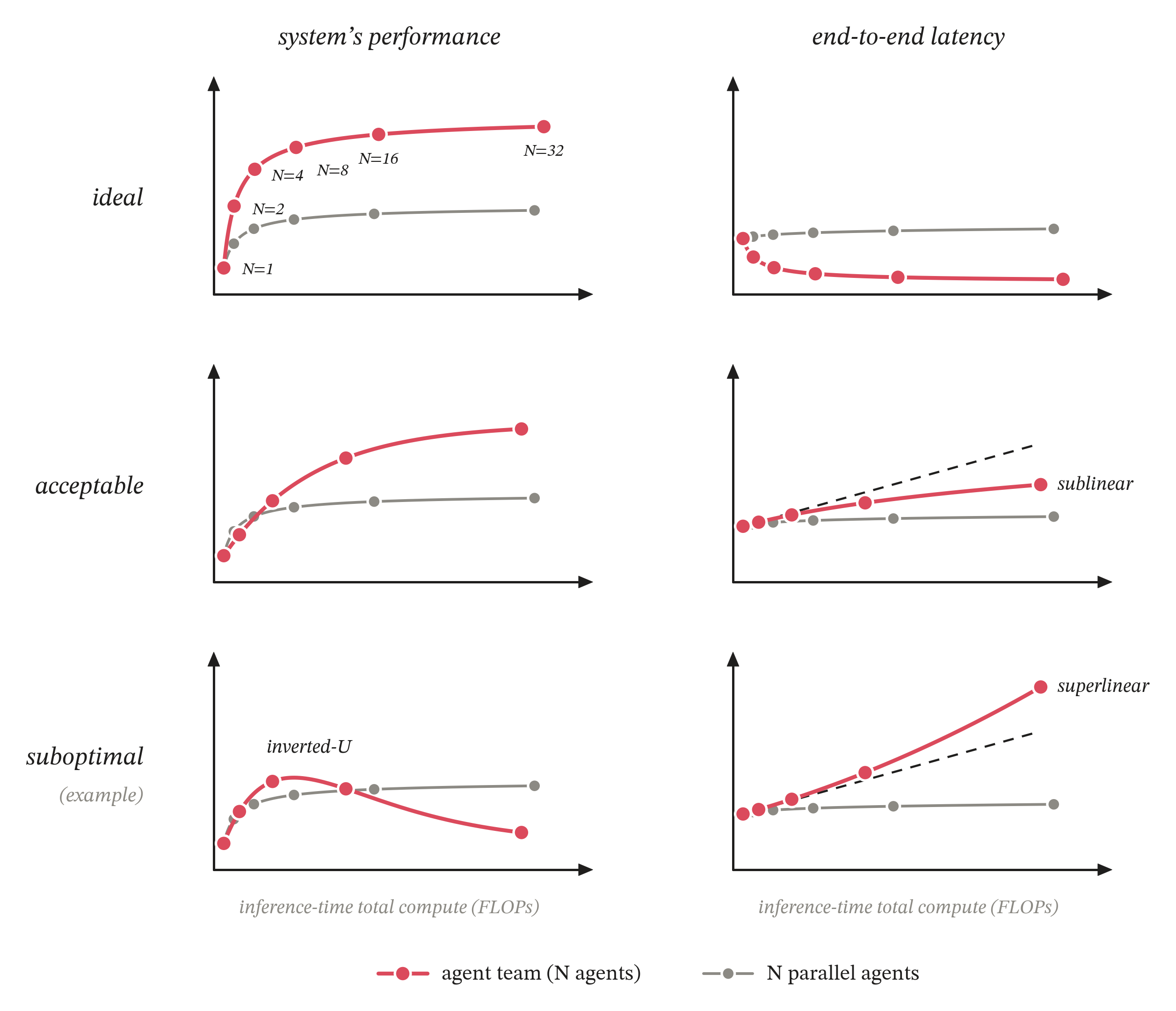
Figure 27. How we suggest plotting scalability (a schematic, not data). The x-axis is the system’s total inference-time compute on a linear scale, and each dot doubles the number of agents. The baseline spends the same compute on parallel agents that never communicate. Performance should rise and then level off, never fall, and stay above the baseline. Latency ideally falls as compute grows. Growing more slowly than compute, below the dashed line that marks linear growth, is acceptable even when it ends above the baseline. The last row is a suboptimal example: performance peaks and then falls, and latency grows faster than compute.
5.4Choosing baselines
Every gain should hold up against the right baselines at a matched budget:
- Single agent thinking longer with the same budget.
- Single agent sampling many answers and committing one result (majority voting or best-of-N), the baseline that proved hardest to beat in the Tradeoff section.
- The same multi-agent system but with communication (information exchange) disabled, which separates what communication adds from what extra attempts add.
- A central orchestrator that decides everything (e.g. splits the task and merges the results), whenever the claim is that a decentralized design does better.
It also helps to report how many independent agents it takes to match the team, as Park et al. (2026) do. For their five-agent team, the answer is the best of 33.
6Learning to coordinate: training and self-evolution
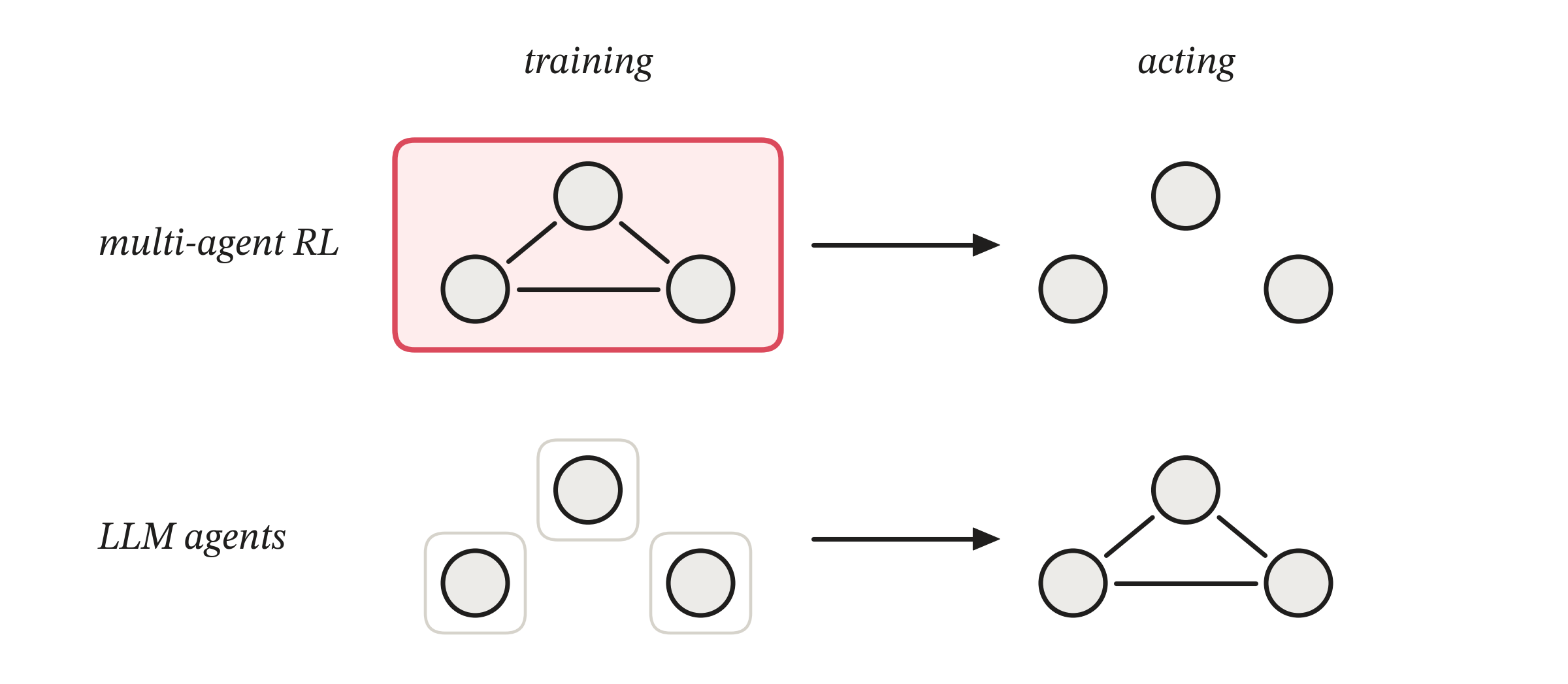
Figure 28. In multi-agent RL, agents are trained together and then act alone. Inference-time LLM agents are trained alone and then act together.
If design alone does not make coordination scale, maybe coordination can be learned.
In multi-agent RL (MARL), agents are trained together and act alone.
Most cooperative multi-agent RL work follows centralized training with decentralized execution (CTDE) (Kraemer and Banerjee 2016). During training, each agent’s critic sees every agent’s observations and actions, so it can judge an agent’s move given what the others are doing (Lowe et al. 2017). The critics are thrown away after training, and at execution time each agent acts on its own observations only.
In inference-time LLM-based multi-agent systems, agents are trained alone and act together.
Each model is trained as a single agent and only put into a team when it is deployed, so whatever coordination happens has to happen at inference time. In practice, models tend to give in to their teammates too easily.
That raises two questions. Can LLM agents learn to work together? And in decentralized settings, where copies of one model start out nearly identical, can learning make them different?
6.1What gets learned, and from what signal
Training updates each agent’s weights with gradients. Self-evolution leaves the weights alone and changes the society instead. The signal can come from the task (a verifier, tests, a benchmark score) or from the agents themselves (agreement, votes, wins against a copy, prices).
| Signal from the task | Signal from the agents | |
|---|---|---|
| Training | MAPoRL (Park et al. 2025), MALT (Motwani et al. 2024) | Multiagent Finetuning (Subramaniam et al. 2025), SPIRAL (Liu et al. 2026), MPT (Xu et al. 2026a) |
| Self-evolution | ADAS (Hu et al. 2025), AFlow (Zhang et al. 2024) | Economy of Minds (Qi et al. 2026b), EvoAgent (Yuan et al. 2025) |
In the left column, MAPoRL and MALT reward answers that a verifier or the known solution marks as right, and ADAS and AFlow search over agent designs scored on a benchmark. In the right column, Multiagent Finetuning trains each copy on its answers that match the majority, SPIRAL has a model play games against itself, and Economy of Minds has agents bid for turns and removes them when their money runs out. MPT learns how to bid, and the bids decide who acts.
Whenever individual agents learn, someone has to decide who earned the team’s success or failure. This is the credit assignment problem. Multi-agent RL has two classic answers. COMA asks how much better an agent’s action was than its other options (Foerster et al. 2018), and QMIX learns a value for each agent and combines them into the team’s value (Rashid et al. 2018). Markets pass credit backward, with the agent that acts paying its bid to the one before it (Qi et al. 2026b; Figure 29). LLM methods mostly borrow from these ideas. MALT samples several continuations from each agent’s output and credits the output by how often they end up correct (Motwani et al. 2024). MAPoRL rewards each agent for its own answer plus the later answers it influenced (Park et al. 2025). Kimi K2.5 sidesteps the problem by training only the orchestrator and freezing its subagents (Kimi Team 2026), and Multiagent Finetuning trains each model only on answers that agree with the majority (Subramaniam et al. 2025).
Figure 29 (Based on Qi et al. 2026b, Sections 2.2–2.3). How Economy of Minds assigns credit. The top row shows the existing agents, each in its own color with its wealth below it, and the squares are the states of the task. Agents that can act bid for each step, and the highest bid wins. Each winner pays its bid to the agent that acted before it (the crimson arcs along the chain), and the agent whose step solves the task collects the reward, so money flows back along the steps that led to success. Agents whose wealth falls below zero are removed, and wealthy agents spawn variants.
6.2Does learning make agents different?
It matters, because agents that start out alike tend to fail together. Training can at least keep the differences that are there. Multiagent Finetuning trains on answers that agree with the majority, yet its agents stay diverse, because each model trains only on its own outputs and the models play different roles (Subramaniam et al. 2025). In SiriuS, a separate model per role beats one model trained on every role (Zhao et al. 2025), and in Werewolf, MaKTO’s model trained against varied opponents beats one trained against copies of itself (Ye et al. 2025).
Often, though, teams collapse. Either one agent ends up doing all the work, or all the agents become alike. Kimi K2.5 ran into the first kind in two forms. Without a bonus for spawning subagents, its orchestrator falls back to doing everything itself, and with the bonus it spawns subagents without really splitting the task (Kimi Team 2026). In ReMA, a planner learns to always skip planning and let the solver answer directly (Wan et al. 2025). Even EvoAgent, which keeps a new agent only if an LLM judges it distinct and useful, stops improving after about three rounds (Yuan et al. 2025).
Neither kind of signal, by itself, keeps agents different. Signals from the agents reward agreeing with the majority or beating the others, so unless something else keeps them apart, the agents converge or one of them takes over. A task reward looks only at the final answer, so the cheapest solution is often one agent doing everything.
6.3How large can these teams get?
Not very large yet. Teams trained by gradient with separate weights for each agent usually have two or three members (Park et al. 2025; Motwani et al. 2024; Zhao et al. 2025; Wan et al. 2025). Larger societies avoid training everyone. They train one agent and freeze the rest (Kimi Team 2026), share one policy among all agents (Gandhi et al. 2026), or search without gradients (Feng et al. 2025).
7Concluding remarks
In 1986, Marvin Minsky described a mind as a society of many small processes, each mindless on its own, and asked how such a society could add up to a mind (The Society of Mind). Forty years later, we are running his experiment in reverse. Modern agents are very capable and very similar, because they run on very similar frontier LLMs. The question seems to be flipped, but the core problems remain the same: how to split the work so that the parts can make progress side by side, how to keep each part’s cognitive load bounded as the society grows, how to prevent parts that are alike from making the same mistakes together, and how to make sure that what passes between them has been checked rather than merely agreed on. Stronger agents make each part better, but they do not make any of these problems go away.
We will soon enter an era where agents are literally everywhere, in numbers even larger than the human population, and interactions non-stop and more intensive than human communications. Living on the internet, they can easily travel to any filesystem and talk to any agent, even intervene in human interactions. It is time to look beyond “multi-agent systems”, a few agents wired together for one task, and to “collective intelligence”: what very large societies of agents do as a whole. Importantly, that study has to ask not only how well a society performs, but also whether the society, and not just each agent in it, stays aligned with what people want, and whether people can still see, steer and stop it. These questions deserve as much attention as performance, and any predictive scaling studies at small scale that can generalize to larger societies would be especially valuable, because they would let us foresee how a society behaves before we build it at full size.
Acknowledgements
We thank Aayush Karan, Yanchen Liu, Yulu Gan, Ced Zhang, Yizhou Liu, Yu Yao, Ao Qu, Leo Yuan, Rulin Shao, Shannon Shen, Weiwei Sun, Zhuokai Zhao, and Furong Huang for helpful discussions and for their comments on earlier drafts of this post. We are also grateful to Prof. David Parkes and Prof. Hima Lakkaraju for their advice.
Citation
If you find this post useful, please cite it as:
@misc{qi2026collective,
  title        = {Steps Towards Artificial Collective Intelligence},
  author       = {Qi, Zhenting and Zhu, Baiyu and Yu, Bowen and Xu, Guowei and Bai, Xingjian and Liang, Qiyao and Yang, Fuming and Du, Yilun},
  year         = {2026},
  month        = nov,
  howpublished = {Blog post},
  url          = {https://zhentingqi.github.io/blogs/steps-towards-artificial-collective-intelligence/}
}
References
Show all 138 references
- Amdahl, G. M. (1967). Validity of the single processor approach to achieving large scale computing capabilities. AFIPS Spring Joint Computer Conference, 483–485.
- Anthropic (2025). How we built our multi-agent research system. Anthropic Engineering, June 13, 2025 (J. Hadfield, B. Zhang, K. Lien, F. Scholz, J. Fox, D. Ford).
- Anthropic (2026a). Formalizing Fermat’s Last Theorem. September 4, 2026.
- Anthropic (2026b). Safely scaling multi-agent teams with Claude Fable 5.2. claude.dev Blog, November 9, 2026 (B. Zhang, T. Peng, E. Najt, K. Scholl, L. Martin).
- ARC Prize Foundation (2026). ARC-AGI-3: A New Challenge for Frontier Agentic Intelligence. arXiv:2603.24621.
- Avizienis, A. (1985). The N-version approach to fault-tolerant software. IEEE Transactions on Software Engineering, SE-11(12), 1491–1501.
- Azerbayev, Z., et al. (2023). ProofNet: Autoformalizing and Formally Proving Undergraduate-Level Mathematics. arXiv:2302.12433.
- Baum, E. B. (1999). Toward a model of intelligence as an economy of agents. Machine Learning, 35(2), 155–185.
- Bay, Y. Y., & Yearick, K. A. (2026). When More Sampling Hurts: The Modal Ceiling and Correlation Ceiling of Test-Time Scaling. arXiv:2606.28661.
- Berlekamp, E. R., Conway, J. H., & Guy, R. K. (1982). Winning Ways for Your Mathematical Plays, Vol. 2. Academic Press.
- Bertalanič, B., & Fortuna, C. (2026a). The Ringelmann Effect in Multi-Agent LLM Systems: A Scaling Law for Effective Team Size. arXiv:2606.02646.
- Bertalanič, B., & Fortuna, C. (2026b). The Cost of Consensus: Isolated Self-Correction Prevails Over Unguided Homogeneous Multi-Agent Debate. arXiv:2605.00914.
- Bertsch, A., et al. (2025). Oolong: Evaluating Long Context Reasoning and Aggregation Capabilities. arXiv:2511.02817.
- Bratton, B., Agüera y Arcas, B., & Manyika, J. (2026). Artificial symbiotic intelligence: Agents, AGI and the orchestration of many minds. DeepMind Institute, September 24, 2026.
- Brent, R. P. (1974). The parallel evaluation of general arithmetic expressions. Journal of the ACM, 21(2), 201–206.
- Brown, B., et al. (2024). Large Language Monkeys: Scaling Inference Compute with Repeated Sampling. arXiv:2407.21787.
- Carlini, N. (2026). Building a C compiler with a team of parallel Claudes. Anthropic Engineering, February 5, 2026.
- Chan, J. S., et al. (2024). MLE-bench: Evaluating Machine Learning Agents on Machine Learning Engineering. ICLR 2025. arXiv:2410.07095.
- Chen, Y., et al. (2026). CoCoBench: A Cooperative Coordination Benchmark for Embodied Multi-Agent Task Planning. arXiv:2608.28266.
- Chen, Z., et al. (2025). BrowseComp-Plus: A More Fair and Transparent Evaluation Benchmark of Deep-Research Agent. arXiv:2508.06600.
- Cheng, A., et al. (2025). Barbarians at the Gate: How AI is Upending Systems Research. arXiv:2510.06189.
- Choi, H. K., et al. (2025). Debate or Vote: Which Yields Better Decisions in Multi-Agent Large Language Models?. NeurIPS 2025. arXiv:2508.17536.
- Coase, R. H. (1960). The problem of social cost. The Journal of Law and Economics, 3, 1–44.
- De Marzo, G., et al. (2026). AI agents can coordinate beyond human scale. Science Advances, 12, eaea6091. arXiv:2409.02822.
- Dean, J., & Ghemawat, S. (2008). MapReduce: Simplified data processing on large clusters. Communications of the ACM, 51(1), 107–113.
- Deng, X., et al. (2025). SWE-Bench Pro: Can AI Agents Solve Long-Horizon Software Engineering Tasks?. arXiv:2509.16941.
- Dong, Y., et al. (2024). VillagerAgent: A Graph-Based Multi-Agent Framework for Coordinating Complex Task Dependencies in Minecraft. arXiv:2406.05720.
- Du, M., et al. (2025). DeepResearch Bench: A Comprehensive Benchmark for Deep Research Agents. arXiv:2506.11763.
- Du, Y., et al. (2023). Improving Factuality and Reasoning in Language Models through Multiagent Debate. ICML 2024. arXiv:2305.14325.
- Erman, L. D., et al. (1980). The Hearsay-II speech-understanding system: Integrating knowledge to resolve uncertainty. ACM Computing Surveys, 12(2), 213–253.
- Feng, S., et al. (2025). Heterogeneous Swarms: Jointly Optimizing Model Roles and Weights for Multi-LLM Systems. NeurIPS 2025. arXiv:2502.04510.
- Foerster, J., et al. (2018). Counterfactual Multi-Agent Policy Gradients. AAAI 2018. arXiv:1705.08926.
- Gandhi, A., et al. (2026). Recursive Agent Optimization. COLM 2026. arXiv:2605.06639.
- Gelernter, D. (1985). Generative communication in Linda. ACM Transactions on Programming Languages and Systems, 7(1), 80–112.
- Goss, S., et al. (1989). Self-organized shortcuts in the Argentine ant. Naturwissenschaften, 76(12), 579–581.
- Grassé, P.-P. (1959). La reconstruction du nid et les coordinations interindividuelles chez Bellicositermes natalensis et Cubitermes sp. La théorie de la stigmergie. Insectes Sociaux, 6(1), 41–80.
- Grötschla, F., et al. (2025). AgentsNet: Coordination and Collaborative Reasoning in Multi-Agent LLMs. arXiv:2507.08616.
- Groves, T. (1973). Incentives in teams. Econometrica, 41(4), 617–631.
- Gunther, N. J. (2008). A General Theory of Computational Scalability Based on Rational Functions. arXiv:0808.1431.
- Gustafson, J. L. (1988). Reevaluating Amdahl’s law. Communications of the ACM, 31(5), 532–533.
- Hayek, F. A. (1945). The use of knowledge in society. The American Economic Review, 35(4), 519–530.
- Heo, D., Kim, J., & Suh, B. (2026). Bad Apples in the Kitchen: How LLM Teams Detect, Correct, and Calibrate Against Their Misaligned Members. arXiv:2611.22342.
- Hewitt, C., Bishop, P., & Steiger, R. (1973). A universal modular ACTOR formalism for artificial intelligence. Proceedings of the 3rd International Joint Conference on Artificial Intelligence, 235–245.
- Hoare, C. A. R. (1978). Communicating sequential processes. Communications of the ACM, 21(8), 666–677.
- Holland, J. H. (1985). Properties of the bucket brigade algorithm. Proceedings of the First International Conference on Genetic Algorithms and Their Applications, 1–7.
- Hölldobler, B., & Wilson, E. O. (2009). The Superorganism: The Beauty, Elegance, and Strangeness of Insect Societies. W. W. Norton.
- Holmström, B. (1982). Moral hazard in teams. The Bell Journal of Economics, 13(2), 324–340.
- Hong, S., et al. (2023). MetaGPT: Meta Programming for A Multi-Agent Collaborative Framework. ICLR 2024. arXiv:2308.00352.
- Hu, S., et al. (2025). Automated Design of Agentic Systems. ICLR 2025. arXiv:2408.08435.
- Huang, J., et al. (2024). Large Language Models Cannot Self-Correct Reasoning Yet. ICLR 2024. arXiv:2310.01798.
- Imajuku, Y., et al. (2025). ALE-Bench: A Benchmark for Long-Horizon Objective-Driven Algorithm Engineering. arXiv:2506.09050.
- Imas, A., Koh, A., & Legg, S. (2026). The Economics of Intelligence: How and when does AGI lead to economic transformation?. DeepMind Institute, October 29, 2026. Based on Organizing Intelligence, arXiv:2611.05417.
- Jha, K., Kleiman-Weiner, M., & Jaques, N. (2026). From Solo to Social Learning: Characterizing Recursive Social Improvement in LLMs. arXiv:2609.38516.
- Jiang, J., et al. (2026). FATE: A Formal Benchmark Series for Frontier Algebra of Multiple Difficulty Levels. ICLR 2026. arXiv:2511.02872.
- Jiang, L., et al. (2025). Artificial Hivemind: The Open-Ended Homogeneity of Language Models (and Beyond). NeurIPS 2025 (Datasets and Benchmarks). arXiv:2510.22954.
- Jimenez, C. E., et al. (2024). SWE-bench: Can Language Models Resolve Real-World GitHub Issues?. ICLR 2024. arXiv:2310.06770.
- Jwalapuram, P., et al. (2026). The Illusion of Multi-Agent Advantage. arXiv:2606.13003.
- Kim, Y., et al. (2025a). Towards a Science of Scaling Agent Systems. arXiv:2512.08296.
- Kim, E., et al. (2025b). Correlated Errors in Large Language Models. ICML 2025. arXiv:2506.07962.
- Kimi Team (2026). Kimi K2.5: Visual Agentic Intelligence. arXiv:2602.02276.
- Knight, J. C., & Leveson, N. G. (1986). An experimental evaluation of the assumption of independence in multiversion programming. IEEE Transactions on Software Engineering, SE-12(1), 96–109.
- Koh, J. Y., et al. (2026). Multi-Agent Computer Use. arXiv:2606.01533.
- Kohli, G. (2026). Nine Judges, Two Effective Votes: Correlated Errors Undermine LLM Evaluation Panels. arXiv:2605.29800.
- Kraemer, L., & Banerjee, B. (2016). Multi-agent reinforcement learning as a rehearsal for decentralized planning. Neurocomputing, 190, 82–94.
- Lan, T., et al. (2025). DeepWideSearch: Benchmarking Depth and Width in Agentic Information Seeking. arXiv:2510.20168.
- Li, G., et al. (2023). CAMEL: Communicative Agents for "Mind" Exploration of Large Language Model Society. NeurIPS 2023. arXiv:2303.17760.
- Li, J., et al. (2024). More Agents Is All You Need. TMLR. arXiv:2402.05120.
- Li, W., et al. (2025). Rethinking Mixture-of-Agents: Is Mixing Different Large Language Models Beneficial? (Self-MoA). arXiv:2502.00674.
- Li, J., et al. (2026). Scaling Behavior of Single LLM-Driven Multi-Agent Systems (SIMAS). arXiv:2606.00655.
- Liu, B., et al. (2026). SPIRAL: Self-Play on Zero-Sum Games Incentivizes Reasoning via Multi-Agent Multi-Turn Reinforcement Learning. ICLR 2026. arXiv:2506.24119.
- Liu, Y. (2026). The Evaluator Dilemma: Does Recursive Self-Improvement Really Improve?. Blog post, November 2, 2026.
- Long, Q., et al. (2024). TeamCraft: A Benchmark for Multi-Modal Multi-Agent Systems in Minecraft. arXiv:2412.05255.
- Lowe, R., et al. (2017). Multi-Agent Actor-Critic for Mixed Cooperative-Competitive Environments. NeurIPS 2017. arXiv:1706.02275.
- Mang, Q., et al. (2025). FrontierCS: Evolving Challenges for Evolving Intelligence. arXiv:2512.15699.
- Mao, Y., et al. (2026). Decentralized Multi-Agent Systems with Shared Context. arXiv:2606.10662.
- Mapstone, G. M. (2014). Global Diversity and Review of Siphonophorae (Cnidaria: Hydrozoa). PLoS ONE, 9(2), e87737.
- Merrill, M. A., et al. (2026). Terminal-Bench: Benchmarking Agents on Hard, Realistic Tasks in Command Line Interfaces. arXiv:2601.11868.
- METR (2026). Brief independent investigation of agents’ behavior, reasoning and collaboration in the OpenAI / Hugging Face hacking incident. August 26, 2026 (R. Greenblatt, A. Cotra, H. Wijk).
- Mieczkowski, E., et al. (2026a). Language Model Teams as Distributed Systems. arXiv:2603.12229.
- Mieczkowski, E., et al. (2026b). Improving the Efficiency of Language Agent Teams with Adaptive Task Graphs. arXiv:2605.06320.
- Minsky, M. (1986). The Society of Mind. Simon & Schuster.
- Moonshot AI (2026). Kimi K2.5: Visual Agentic Intelligence. Kimi Research Blog.
- Motwani, S. R., et al. (2024). MALT: Improving Reasoning with Multi-Agent LLM Training. COLM 2025. arXiv:2412.01928.
- Mu, C., et al. (2026). Adaptive Theory of Mind for LLM-based Multi-Agent Coordination. arXiv:2603.16264.
- Munro, C., et al. (2019). Morphology and development of the Portuguese man of war, Physalia physalis. Scientific Reports, 9, 15522.
- Myerson, R. B. (1981). Optimal auction design. Mathematics of Operations Research, 6(1), 58–73.
- Nii, H. P. (1986). Blackboard systems, part one: The blackboard model of problem solving and the evolution of blackboard architectures. AI Magazine, 7(2), 38–53.
- Okawa, M. (2026). Emergence of Biased Consensus in Multi-Agent LLM Debates. ICML 2026. arXiv:2608.02827.
- OpenAI (2026a). On the Navier–Stokes Millennium Prize Problem. September 8, 2026.
- OpenAI (2026b). The Hugging Face incident and the road ahead. August 26, 2026.
- Ostrom, E. (1990). Governing the Commons: The Evolution of Institutions for Collective Action. Cambridge University Press.
- Ouyang, A., et al. (2025). KernelBench: Can LLMs Write Efficient GPU Kernels?. arXiv:2502.10517.
- Pal, S., Wang, F. Y., & Buehler, M. J. (2026). SwarmWorld: Stigmergic technological evolution in societies of language-model agents. arXiv:2608.26081.
- Park, C., et al. (2025). MAPoRL: Multi-Agent Post-Co-Training for Collaborative Large Language Models with Reinforcement Learning. ACL 2025. arXiv:2502.18439.
- Park, J., et al. (2026). Scaling Discovery through Test-Time Communication. arXiv:2609.21032.
- Pimpalgaonkar, S., et al. (2026). Multi Agent Coordination Bench. Bespoke Labs Blog, November 18, 2026.
- Qi, Z., et al. (2026a). Scaling Multi-Agent Intelligence with Substrate-Centric Coordination (ScaleMAS). arXiv:2610.16120.
- Qi, Z., et al. (2026b). Economy of Minds: Emerging Multi-Agent Intelligence with Economic Interactions. NeurIPS 2026. arXiv:2606.02859.
- Qian, C., et al. (2023). ChatDev: Communicative Agents for Software Development. ACL 2024. arXiv:2307.07924.
- Qu, A., et al. (2026). CORAL: Towards Autonomous Multi-Agent Evolution for Open-Ended Discovery. arXiv:2604.01658.
- Rashid, T., et al. (2018). QMIX: Monotonic Value Function Factorisation for Deep Multi-Agent Reinforcement Learning. ICML 2018. arXiv:1803.11485.
- Rendell, P. (2002). Turing universality of the game of life. In Collision-Based Computing (pp. 513–539). Springer.
- Reynolds, C. W. (1987). Flocks, herds and schools: A distributed behavioral model. ACM SIGGRAPH Computer Graphics, 21(4), 25–34.
- Shen, S. Z., et al. (2026). World of SWECraft: Agent Collaboration at Scale via Simulated Software Worlds. arXiv:2610.24061.
- Shen, Z., et al. (2025). REAL-Prover: Retrieval Augmented Lean Prover for Mathematical Reasoning. arXiv:2505.20613.
- Smith, A. (1776). An Inquiry into the Nature and Causes of the Wealth of Nations. W. Strahan and T. Cadell, London.
- Smith, R. G. (1980). The contract net protocol: High-level communication and control in a distributed problem solver. IEEE Transactions on Computers, C-29(12), 1104–1113.
- Song, X., et al. (2026). WebSwarm: Recursive Multi-Agent Orchestration for Deep-and-Wide Web Search. arXiv:2607.08662.
- Subramaniam, V., et al. (2025). Multiagent Finetuning: Self Improvement with Diverse Reasoning Chains. ICLR 2025. arXiv:2501.05707.
- Tomasev, N., et al. (2026). Agentic Economies for Autonomous Scientific Discovery. arXiv:2609.31562.
- Tran, D., & Kiela, D. (2026). Single-Agent LLMs Outperform Multi-Agent Systems on Multi-Hop Reasoning Under Equal Thinking Token Budgets. arXiv:2604.02460.
- Vickrey, W. (1961). Counterspeculation, auctions, and competitive sealed tenders. The Journal of Finance, 16(1), 8–37.
- Virk, Y., et al. (2026). SwarmResearch: Orchestrating Coding Agents for Open-Ended Discovery. arXiv:2607.02807.
- von Neumann, J. (1956). Probabilistic logics and the synthesis of reliable organisms from unreliable components. In Automata Studies, Princeton University Press, 43–98.
- Wan, Z., et al. (2025). ReMA: Learning to Meta-think for LLMs with Multi-Agent Reinforcement Learning. NeurIPS 2025. arXiv:2503.09501.
- Wang, M., et al. (2024). Leave No Document Behind: Benchmarking Long-Context LLMs with Extended Multi-Doc QA. EMNLP 2024. arXiv:2406.17419.
- Wang, X., et al. (2022). Self-Consistency Improves Chain of Thought Reasoning in Language Models. ICLR 2023. arXiv:2203.11171.
- Waters, J. S., et al. (2010). Allometric scaling of metabolism, growth, and activity in whole colonies of the seed-harvester ant Pogonomyrmex californicus. The American Naturalist, 176(4), 501–510.
- Wen, H., et al. (2025). ParaThinker: Native Parallel Thinking as a New Paradigm to Scale LLM Test-time Compute. arXiv:2509.04475.
- Wong, R., et al. (2025). WideSearch: Benchmarking Agentic Broad Info-Seeking. ICLR 2026. arXiv:2508.07999.
- Wu, Q., et al. (2023). AutoGen: Enabling Next-Gen LLM Applications via Multi-Agent Conversation. arXiv:2308.08155.
- Wynn, A., et al. (2025). Talk Isn't Always Cheap: Understanding Failure Modes in Multi-Agent Debate. ICML 2025 Workshop on Multi-Agent Systems. arXiv:2509.05396.
- Xie, J., et al. (2024a). TravelPlanner: A Benchmark for Real-World Planning with Language Agents. ICML 2024. arXiv:2402.01622.
- Xie, T., et al. (2024b). OSWorld: Benchmarking Multimodal Agents for Open-Ended Tasks in Real Computer Environments. NeurIPS 2024. arXiv:2404.07972.
- Xu, G., et al. (2026a). Learning Self-Orchestration in Decentralized Agent Swarms. arXiv:2610.22322.
- Xu, Z., et al. (2026b). WideSeek-R1: Exploring Width Scaling for Broad Information Seeking via Multi-Agent Reinforcement Learning. arXiv:2602.04634.
- Yang, Y., et al. (2026a). Understanding Agent Scaling in LLM-Based Multi-Agent Systems via Diversity. arXiv:2602.03794.
- Yang, J., et al. (2026b). ProgramBench: Can Language Models Rebuild Programs From Scratch?. arXiv:2605.03546.
- Yao, S., et al. (2024). τ-bench: A Benchmark for Tool-Agent-User Interaction in Real-World Domains. ICLR 2025. arXiv:2406.12045.
- Ye, R., et al. (2025). Multi-agent KTO: Reinforcing Strategic Interactions of Large Language Model in Language Game. NeurIPS 2025. arXiv:2501.14225.
- Yu, W., et al. (2026). When Do Multi-Agent Systems Help? An Information Bottleneck Perspective. arXiv:2607.16133.
- Yuan, S., et al. (2025). EvoAgent: Towards Automatic Multi-Agent Generation via Evolutionary Algorithms. NAACL 2025. arXiv:2406.14228.
- Zhan, Z., et al. (2026). Agensh: Scaling Organizational Intelligence to 1,024 Agents. arXiv:2609.26781.
- Zhang, J., et al. (2024). AFlow: Automating Agentic Workflow Generation. ICLR 2025. arXiv:2410.10762.
- Zhang, M., et al. (2026a). ExplorationBench: Measuring AI Systems' Exploration in Verifiable Alien Worlds. arXiv:2609.30199.
- Zhang, Y., et al. (2026b). Silo-Bench: A Scalable Environment for Evaluating Distributed Coordination in Multi-Agent LLM Systems. arXiv:2603.01045.
- Zhao, W., et al. (2024). Commit0: Library Generation from Scratch. ICLR 2025. arXiv:2412.01769.
- Zhao, W., et al. (2025). SiriuS: Self-improving Multi-agent Systems via Bootstrapped Reasoning. NeurIPS 2025. arXiv:2502.04780.